

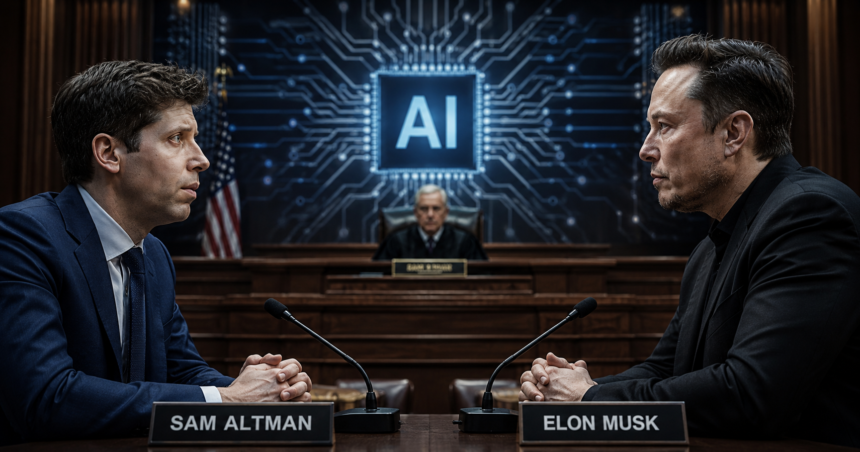
The biggest tech trial of 2026 is happening right now. Here’s what’s at stake and what Sam Altman said on the stand.
Two of the most powerful names in artificial intelligence are facing off in a federal courtroom in Oakland, California, and the outcome could reshape the future of AI as we know it. Elon Musk is suing OpenAI CEO Sam Altman, claiming Altman betrayed the company’s founding mission and essentially stole a charity for personal profit. This week, Altman finally took the stand to tell his side of the story.
For more breaking U.S. tech and business news, follow our latest coverage at BrieflyUSA.
What Is This Trial Actually About?
Musk, the wealthiest man in the world, has sued Altman and OpenAI president Greg Brockman on the basis that they “stole a charity” by shifting its purpose. He alleged that OpenAI’s leader persuaded him to invest $38 billion, based on a goal of improving humanity, only to see the company pivot to a for-profit venture in 2019.
The trial, now in its third week, pits two of the tech world’s biggest personalities against one another in a high-stakes clash that could usher in major changes for one of the world’s leading artificial intelligence companies and potentially alter the AI landscape.
More Read

You can track the official court filings through the U.S. District Court for the Northern District of California.
What Did Sam Altman Say on the Stand?
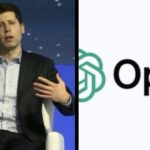
Altman took the stand on Tuesday to defend himself against accusations from co-founder-turned-adversary Elon Musk that he “stole a charity” by converting the maker of ChatGPT into a for-profit company.
Altman flipped the narrative entirely, painting Musk as the one who abandoned OpenAI, not the other way around.
More Read

OpenAI CEO Sam Altman testified that Musk, who co-founded OpenAI alongside him in 2015, did not keep his promises and eventually deserted the young startup as it was trying to chart its path forward.
On Musk’s claim that he was misled, Altman told the court: “It does not fit with my conception of the words ‘stealing a charity’ to look at what has actually happened here.”
Altman also revealed a stunning detail about what Musk originally wanted from the company: “An early number that Mr. Musk threw out was that he should have 90 percent of the equity to start. It then softened, but it always was a majority.”
What Is Musk Asking For?
The stakes could not be higher. If the court finds Altman, Brockman and Microsoft liable for Musk’s two civil claims, “breach of charitable trust” and “unjust enrichment,” Musk has asked for them to “disgorge” up to $150 billion to the nonprofit entity.
Beyond the money, as part of his lawsuit, Musk is pushing for the removal of Altman and Brockman from OpenAI entirely.
How Did OpenAI Go From Nonprofit to For-Profit?
Much of the trial has centered around a series of contentious negotiations that took place between Musk, Altman, Brockman and Ilya Sutskever, another OpenAI co-founder, in 2017 and 2018. The executives agreed they needed to raise more money for computing resources, and they debated a range of potential corporate structures, including for-profit options, that could help them do so. The talks ultimately collapsed without a clear resolution, and Musk left OpenAI’s board in February 2018.
More Read

After Musk’s departure, the company moved forward without him. Musk left the board in 2018, and Altman called that a morale boost for employees who did not like his “hardcore” approach.
Musk, in private emails now revealed in court, was deeply pessimistic about OpenAI’s chances. He wrote: “My probability assessment of OpenAI being relevant to DeepMind/Google without a dramatic change in execution and resources is 0%. Not 1%.” Altman told the court that line was “burned into my memory.”
What Has Musk Argued in Court?
Musk’s lawyers made the case that OpenAI, Altman and OpenAI president Greg Brockman, with the help of investments from Microsoft, jettisoned OpenAI’s founding mission of being a non-profit focused on creating advanced AI for the benefit of humanity.
During his own testimony earlier in the trial, Musk was very combative while OpenAI’s lawyer, William Savitt, asked him questions. Musk accused Savitt of lying and asking misleading questions. The pair argued back and forth on several occasions, and both men raised their voices.
Musk has also gone further, arguing the stakes go beyond money. “If you have someone who is not trustworthy in charge of AI, I think that’s a very big danger for the whole world,” Musk said.
What Is OpenAI Worth Now?
In February, OpenAI announced $110 billion in new funding at a pre-money valuation of $730 billion. The round includes $30 billion from SoftBank, $30 billion from Nvidia and $50 billion from Amazon.
The trial comes as OpenAI prepares for a potential initial public offering that could see it valued at $1 trillion, a historically large sum. That IPO could be directly affected by the verdict. Read more about OpenAI’s financial structure on CNBC’s dedicated OpenAI coverage.
What Does the Public Think About AI?
The timing of this trial is revealing. A March 2026 poll by the Pew Research Center suggested that a majority of respondents in the U.S. believe AI will worsen, rather than improve, the ability to think creatively, form meaningful relationships, make difficult decisions, and solve problems. Just 10 percent of respondents said they were more excited than concerned about the increased use of AI in daily life.
You can read the full Pew findings at pewresearch.org.
What Happens Next?
The trial is still ongoing in Oakland, with cross-examination of Altman continuing. A verdict could come within weeks and would have immediate consequences for OpenAI’s leadership, its planned IPO, and potentially how AI companies in the U.S. are regulated going forward.
OpenAI’s legal team has argued that Musk is motivated by sour grapes and is out to damage a competitor. Musk runs his own AI company, xAI, which produces the Grok chatbot, putting him in direct competition with the company he helped found.
Stay up to date on this trial and all major U.S. tech and business stories at BrieflyUSA.
Bottom Line
The Musk vs. Altman trial is the most watched tech courtroom battle of 2026. At its core it is a fight over who controls the future of artificial intelligence, whether a nonprofit mission can survive Silicon Valley’s hunger for profit, and whether the man who helped start ChatGPT built something great or simply stole it. Whatever the jury decides, the AI industry will never look quite the same.