

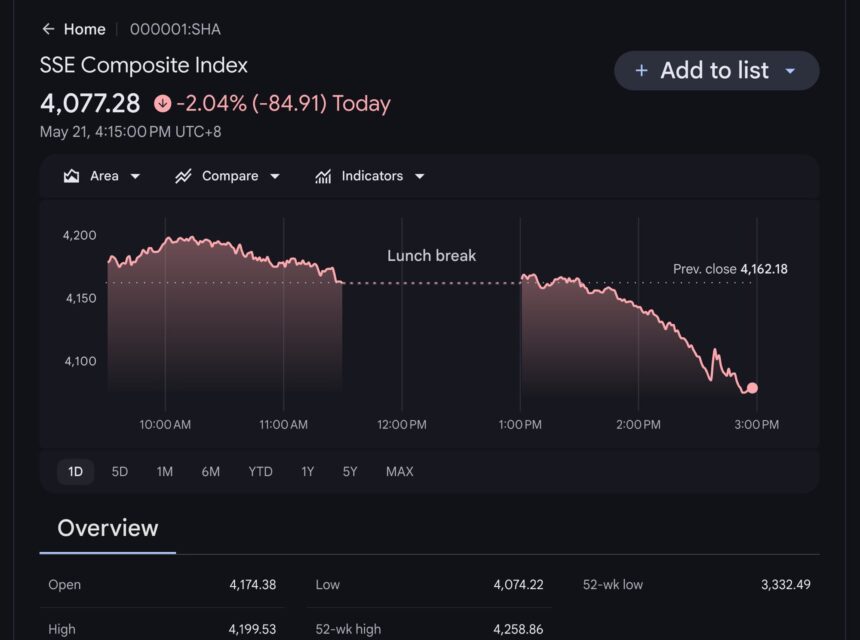
Beijing, China, May 21, 2026 — China experienced significant turbulence in its financial markets today as the Shanghai Composite Index dropped 2.04 percent to close at 4,077.28 points. This decline erased more than two trillion RMB, equivalent to approximately 293.8 billion US dollars, in market value. The sharp fall reflects ongoing challenges in the China economy and comes at a time when Beijing authorities are navigating multiple domestic and international issues.
Market Turmoil in Shanghai
Traders in China reported heavy selling pressure throughout the trading session in Shanghai. The index opened lower and continued to slide as investor confidence wavered over persistent concerns about growth prospects in key sectors. This event highlights the volatility that has characterized Chinese stock markets in recent years.
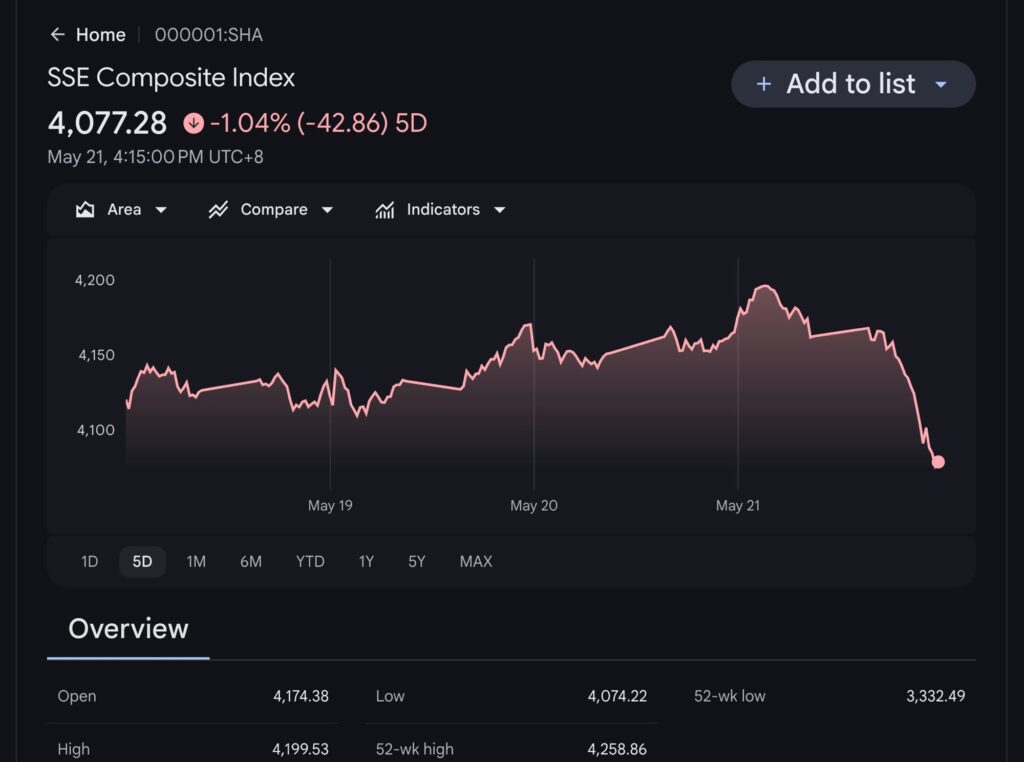
Tech Rout Erases Weekly Gains: Shanghai Composite Plunges From Peak to Post a 1.04% 5-Day Loss
A multi-day rally for China’s benchmark SSE Composite Index came to an abrupt halt on Thursday, May 21, 2026. After hitting a 5-day high near 4,200 points in early trading, a severe afternoon sell-off wiped out the week’s progress, pulling the index down 1.04% (a loss of 42.86 points) over the 5-day period to close at 4,077.28. While sectors like civil aviation and banking saw positive movement earlier in the week, a sharp retreat in heavily weighted semiconductor and memory chip stocks ultimately dragged the index down to its lowest level since mid-May.
Sources
• Data Verification: Google Finance / Trading Economics (Historical 5-day chart data for SSE Composite Index 000001:SHA, tracking performance from May 15 to May 21, 2026).
• Market Reporting: Xinhua News Agency, “Chinese shares close lower Thursday” (May 21, 2026) – detailing the 3.48 trillion yuan combined turnover surge and sectoral losses.
Analysts link the downturn to potential capital outflows and efforts by authorities to stabilize the situation. Reports suggest that China may be selling United States Treasury holdings to support domestic markets. China holdings of US Treasuries have decreased over time as part of a diversification strategy. This approach allows Beijing to manage reserves while addressing pressures from the property sector and other economic headwinds in China.
Economists monitoring China performance noted that the Shanghai Composite had shown resilience earlier but faced renewed selling amid global uncertainties. Over the past month the index declined modestly by about 0.71 percent even as it remains up more than 20 percent from a year ago. However the daily drop of over 84 points today signaled acute sensitivity to current conditions in China.
Innovation Amid Economic Challenges
This market weakness arrives alongside notable advancements in China. In technology, China has launched the world’s first commercial offshore wind-powered underwater data center near Shanghai. This project underscores China commitment to expanding computing infrastructure to support artificial intelligence and digital economy goals.
More Read

Meanwhile, Chinese cities have begun deploying AI powered robot barber kiosks that offer low cost haircuts with high precision. These initiatives in places like Shenzhen demonstrate China push toward integrating robotics into everyday services and reflect broader efforts to modernize urban life across the nation.
Geopolitical Developments Involving China
Geopolitically, China delayed a planned visit by a senior United States Pentagon official amid tensions over a proposed arms package for Taiwan. Beijing has used this as leverage in discussions with Washington, illustrating the complex dynamics in China foreign relations.
Additionally, Chinese President Xi Jinping is expected to visit North Korea soon, marking a significant diplomatic move. This trip coincides with other high level engagements, including recent summits with Russian President Vladimir Putin in Beijing that strengthened China Russia ties.
More Read

China engagement with partners like Russia has deepened. Recent meetings in Beijing between Xi Jinping and Putin emphasized strategic coordination and warned of global challenges. These ties provide China with alternative avenues for economic cooperation amid frictions with Western nations.
The visa free travel extension between Russia and China until 2027 further facilitates people to people exchanges and business opportunities. This policy benefits tourism and short term visits highlighting practical aspects of China bilateral relationships.
On the technology front China recent actions regarding semiconductor imports including restrictions on certain Nvidia products illustrate efforts to balance domestic innovation with external dependencies. These moves occur as companies in China accelerate research into self reliant AI and computing capabilities.
Economic Context and Policy Outlook
This development in the China stock market occurs against a backdrop of mixed signals in the national economy. Growth in China has faced challenges from real estate adjustments and shifting global trade patterns. At the same time sectors like technology and renewable energy continue to attract attention as areas of strategic importance for China future competitiveness.
In response to the downturn, officials in China are expected to monitor liquidity and investor sentiment closely. Past interventions by Chinese regulators have included measures to bolster confidence such as adjusting margin requirements or encouraging state backed entities to purchase shares. Whether similar steps will be taken remains to be seen but the scale of the value loss underscores the stakes for policymakers in Beijing.
Market participants in China are watching for any signals from the central bank or government regarding stimulus. The property sector which has weighed on overall sentiment for some time continues to require careful management. Declines in stock values can exacerbate concerns if they lead to reduced wealth effects among households in China.
More Read

Global investors have maintained exposure to Chinese assets despite volatility. Funds tracking China equities saw inflows in periods of optimism but today reversal highlights the need for caution. The Hang Seng index in Hong Kong also faced pressure reflecting interconnected sentiment across greater China markets.
Looking Ahead for China
Authorities in China have emphasized stability in recent communications. Efforts to promote high quality development and technological self sufficiency aim to build resilience against such fluctuations. Projects like the offshore data center and AI applications in daily services exemplify this forward looking strategy in China.
Diplomatically the anticipated trip by Xi Jinping to North Korea could address regional security matters and bilateral cooperation. It adds to a busy schedule for Chinese leadership that includes managing relations with the United States and strengthening partnerships in Asia and beyond.
In summary today market drop in China serves as a reminder of the challenges inherent in sustaining momentum for the world second largest economy. While innovation hubs in Shanghai and Shenzhen push boundaries in technology and automation financial markets reflect immediate pressures. Policymakers in Beijing will likely weigh options to restore confidence while advancing long term goals for China.
This situation will continue to draw attention from observers worldwide as developments unfold in the coming days. The interplay between domestic economic management and international diplomacy will shape outcomes for China in the months ahead.