

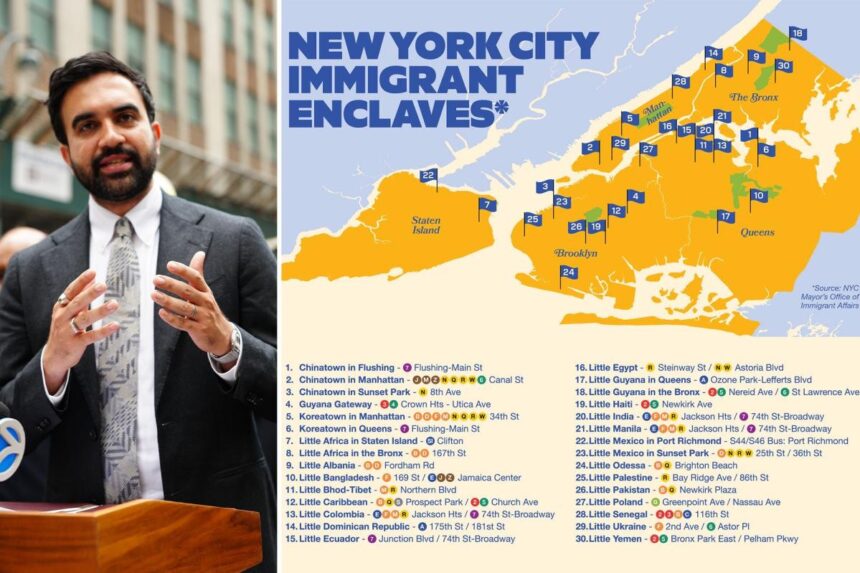
New York City Mayor Zohran Mamdani’s administration is under fire after releasing an official map of the city’s “immigrant enclaves” that left out the historic Little Italy neighborhood in Manhattan. The omission has drawn sharp criticism from Italian-American leaders, who called it disrespectful to generations of immigrants who helped shape the city.
The “New York City Immigrant Enclaves” guide, produced by the Mayor’s Office of Immigrant Affairs in partnership with NYC Tourism + Conventions, highlights 30 neighborhoods across the five boroughs as part of a “Neighborhood Passport” tourism campaign tied to the 2026 FIFA World Cup. It features areas such as Little Palestine in Bay Ridge, Brooklyn; Little Egypt in Astoria, Queens; Little Pakistan in Brooklyn; multiple Chinatowns; Little Guyana; Little Mexico; and Little Yemen. However, it excludes iconic historic districts like Little Italy, as well as notable Irish and Jewish enclaves.
Italian-American groups and elected officials quickly condemned the map as incomplete and insulting. Leaders emphasized that Little Italy represents one of New York’s foundational immigrant communities, established in the late 19th century by waves of Italian arrivals who built businesses, churches, and neighborhoods that remain cultural landmarks today.
“As Italian Americans, you mess with one of us, you messed with all of us,” Italian-American leaders stated in response to the controversy.
The Italian American Civil Rights League (IACRL) described the exclusion as “cultural erasure,” calling Little Italy “sacred ground” where Italian immigrants “came with nothing, worked like hell, opened shops, raised families, built churches, fed the city, and helped make New York what it is.” The group also noted prior tensions, including a denied permit for Unity Day 2026.
More Read

New York City Council’s Italian Caucus labeled the map “incomplete at best and insulting at worst,” accusing the administration of erasing Italian-Americans from the city’s immigrant story. Councilwoman Joann Ariola (R-Queens), co-chair of the caucus, highlighted the irony of including newer enclaves like “Little Bhod-Tibet” while overlooking the “original Little” neighborhood and Irish areas such as Woodlawn in the Bronx.
Shop owners in Little Italy reported the map already confusing tourists and potentially hurting business during the busy World Cup visitor season.
Mayor Mamdani’s Response and Defense
Facing mounting pressure, Mayor Mamdani addressed the issue at a July 10 press conference. He stated that the map originated under the prior Eric Adams administration in 2023, with his team adding only a few neighborhoods. Mamdani described it as “clearly not an exhaustive list of the more than 200 ethnic communities that call our city home” and pledged updates, specifically confirming that Little Italy would be added.
More Read

City spokespeople noted that the guide focuses on neighborhoods with substantial foreign-born populations rather than every ethnic or religious group. They pointed to the inclusion of Little Odessa (which has a substantial Jewish population) as evidence that Jewish communities were not intentionally excluded.
Critics, however, disputed the claim that the map was purely inherited from the previous administration, noting differences from earlier Immigrant Heritage Week materials.
Historical Significance of Little Italy
Little Italy stands as one of Manhattan’s most recognizable historic districts and a symbol of Italian immigration to America. Established in the late 1800s, it became home to tens of thousands of Italian immigrants and remains a major tourist draw known for its restaurants, festivals, and cultural heritage. Similar “Little” neighborhoods honoring other groups have proliferated in recent decades, making the exclusion of this foundational enclave particularly striking to community advocates.
Broader backlash also came from Jewish and Irish New Yorkers, who noted the absence of their historic enclaves such as Borough Park and Woodside. Social media amplified the debate, with commentators questioning why certain communities received prominent recognition while others did not.
What’s Next for the Map and NYC’s Immigrant Narrative
Mayor Mamdani has committed to revising the map to include Little Italy and making further adjustments. Italian-American organizations are calling for a full review to ensure historic contributions from all communities including Italian, Irish, and Jewish New Yorkers are properly represented in city tourism and heritage materials.
The controversy highlights ongoing debates about how New York recognizes its diverse immigrant history amid a major international event like the World Cup. As the city prepares to welcome global visitors, leaders on all sides stress the importance of an inclusive approach that honors the full spectrum of communities that built modern New York.
More Read

The story continues to develop as the administration works on updates and community groups monitor the changes. Little Italy remains a vibrant part of the city’s identity, and its recognition on official maps appears set to be restored following the public outcry.