


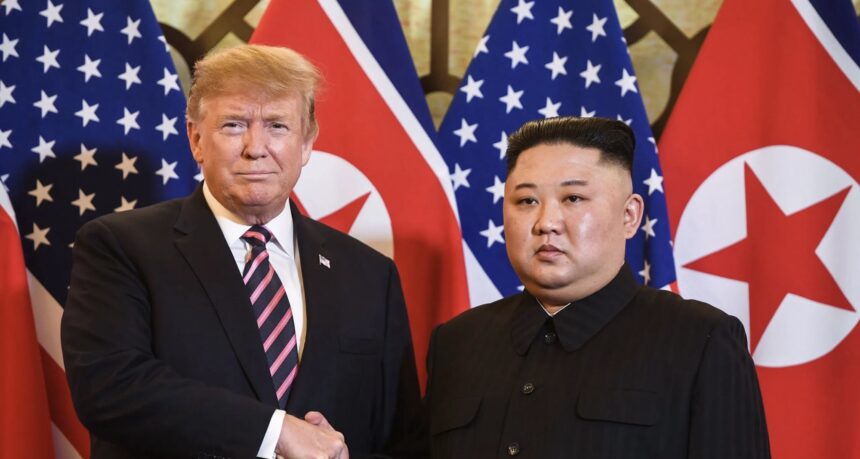
Washington and Seoul are buzzing with fresh signals that the United States may once again pursue direct engagement with North Korea on its nuclear program. South Korean President Lee Jae-myung revealed Friday that he discussed the issue with President Donald Trump on the sidelines of the G7 summit in France. Lee said Trump agreed to consider a phased strategy that would first focus on halting North Korea’s nuclear and missile production, weapons exports, and long-range missile advances in the short term, while keeping full denuclearization as a longer-term goal.
Trump reportedly told Lee it was “time to pay attention” to North Korea and expressed frustration with how past efforts had unfolded. He appeared open to resuming dialogue with North Korean leader Kim Jong-un, though he remained cautious about the next steps. Lee described Trump’s reaction to the phased idea as “it could be one way,” adding that the U.S. president would think it over carefully.
These comments come amid renewed interest in the long-stalled U.S.-North Korea relationship. A post circulating on social media claimed Trump wants to restart negotiations specifically to disarm North Korea and even floated the possibility of removing Kim Jong-un and replacing him as supreme leader. Official statements and reporting so far make no mention of any regime-change element. The focus remains squarely on diplomatic channels and managing the nuclear threat rather than any dramatic leadership overhaul.
A History of High-Stakes Summits
Trump and Kim first met in Singapore in June 2018. The handshake between the two leaders made global headlines as the first-ever meeting between a sitting U.S. president and a North Korean supreme leader. They signed a joint statement committing to new peaceful relations, security guarantees for North Korea, the denuclearization of the Korean Peninsula, and the return of U.S. war remains. Follow-up working-level talks were supposed to build on that momentum.
The second summit in Hanoi in February 2019 ended abruptly on the second day. The two sides could not bridge the gap between North Korea’s demand for major sanctions relief and the U.S. insistence on concrete steps toward dismantling key nuclear facilities. Trump walked away rather than accept what he viewed as an incomplete deal. No further leader-level meetings occurred during the remainder of his first term.
Now back in office, Trump has repeatedly spoken warmly about his past personal rapport with Kim. During a 2025 Asia trip he said he would be open to another meeting if Kim wanted one. In March 2026 he reportedly told South Korea’s prime minister that he still maintains a good relationship with the North Korean leader and wondered whether Kim was interested in talking again.
Kim, for his part, has also referenced those earlier encounters positively. In September 2025 he said he still has “good memories” of Trump and indicated North Korea would be willing to sit down if the United States dropped what Pyongyang calls its “obsession with denuclearization” and instead pursued peaceful coexistence based on recognition of reality on the ground.
North Korea’s Current Position and Leverage
North Korea has made clear its nuclear arsenal is permanent. Kim has described the weapons as essential to the country’s sovereignty and has declared denuclearization off the table in previous statements. Independent estimates put Pyongyang’s stockpile at around 50 warheads, with ongoing production of fissile material and delivery systems. The regime has strengthened ties with Russia, supplying weapons and even troops for the war in Ukraine, which has given it new economic lifelines and diplomatic cover.
This reality shapes any new talks. A purely denuclearization-focused approach faces the same obstacles that sank the Hanoi summit. A phased or freeze-first strategy, as Lee proposed, could offer a more realistic starting point. It would aim to cap further growth in North Korea’s arsenal, stop missile exports, and limit advances in intercontinental ballistic missiles while sanctions relief or other incentives are negotiated in stages.
South Korea appears willing to support such flexibility. Lee has said his government would accept a Trump-Kim deal that freezes production rather than immediately eliminates every warhead. Japan and other regional allies, however, remain wary of any arrangement that appears to legitimize North Korea as a nuclear power without ironclad verification.
Challenges Ahead
Verification has always been the sticking point. Past agreements collapsed partly because North Korea resisted intrusive inspections. Any new deal would need robust monitoring mechanisms, yet Pyongyang has shown little appetite for allowing outsiders deep access to its facilities.
Sanctions relief is another flashpoint. North Korea wants broad easing of economic pressure. The United States and its partners want to see tangible steps on nuclear and missile programs first. With Russia and China continuing to shield North Korea at the United Nations, enforcing existing sanctions has already grown more difficult.
Domestic politics in Washington add another layer. Critics on both sides of the aisle could attack any deal as either too soft or unrealistic. Supporters argue that personal diplomacy worked once before to reduce tensions and that a new round of talks could at least prevent further escalation.
What a Realistic Path Might Look Like
Analysts suggest several possible outcomes short of full denuclearization. A verified freeze on fissile material production and missile testing could buy time and reduce immediate risks. Confidence-building measures, such as resuming family reunions or easing restrictions on humanitarian aid, might accompany early steps. Security assurances short of a formal treaty could address North Korea’s stated fears of regime change.
Trump has long styled himself as a dealmaker who can succeed where others failed. His team will likely emphasize “peace through strength,” pairing any diplomatic overture with continued military readiness alongside South Korea and Japan. Joint exercises have continued or even expanded in recent years, sending a clear message that the U.S. alliance remains firm.
Regional and Global Stakes
Stability on the Korean Peninsula affects far more than just the two Koreas. Japan lives under the constant shadow of North Korean missiles. China watches closely, preferring a stable but nuclear North Korea over any scenario that brings U.S. forces closer to its border or sparks refugee flows. Russia benefits from North Korea’s distraction of Western attention and its supply of artillery shells and troops.
A successful round of talks could ease some of these pressures and open space for broader regional diplomacy. Failure, or another high-profile collapse, could accelerate North Korea’s weapons development and deepen its alignment with Moscow and Beijing.
For now, the signals point to cautious openness rather than imminent breakthroughs. Lee’s comments Friday represent the most concrete public update in months. Whether working-level contacts resume soon, or whether Trump and Kim eventually meet again, will depend on behind-the-scenes maneuvering that has only just begun.
The social media claim about removing Kim Jong-un appears to be an exaggeration of the actual diplomatic signals. Real progress, if it comes, is more likely to involve incremental steps on nuclear restraint than any sudden leadership change. The coming weeks and months will show whether the renewed interest in dialogue can translate into concrete movement or whether it fades into another round of familiar stalemate.
As with every previous chapter in this long saga, the path forward remains uncertain but worth watching closely. The stakes for regional security and global nonproliferation are simply too high to ignore.