


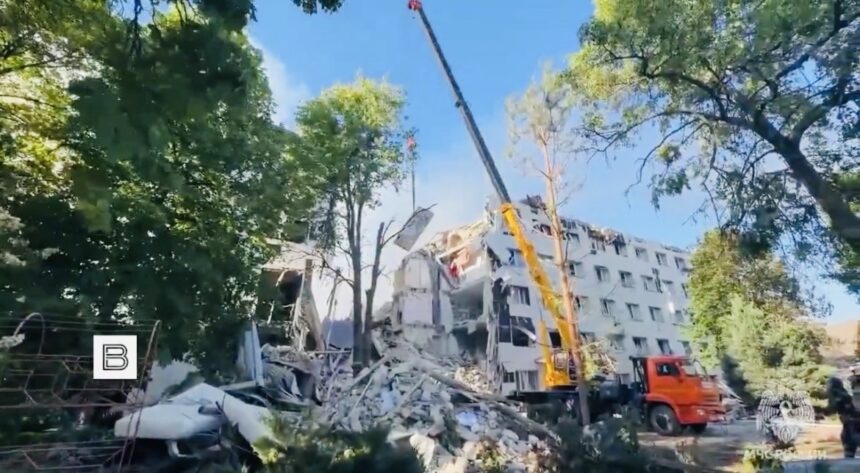
Starobilsk, Luhansk Region – In the early hours of May 22, 2026, a Ukrainian drone strike hit a student dormitory at the Starobilsk Professional College of Luhansk Pedagogical University in Russian-occupied eastern Ukraine, killing at least four people and injuring around 35 others, many of them teenagers. Russian officials described the incident as a deliberate attack on sleeping children, labeling it a “monstrous crime” and “terrorism.” Ukrainian authorities have not publicly commented on the strike as of this writing.
The five-story dormitory building partially collapsed after being struck by what Russian sources described as four fixed-wing unmanned aerial vehicles (UAVs). Rescue operations by Russia’s EMERCOM (Emergency Situations Ministry) faced challenges, with reports of additional people possibly trapped under rubble. Operations were temporarily suspended due to fears of follow-up strikes. Video footage circulating on social media and shared by Russian channels shows emergency workers in orange uniforms carefully removing heavy concrete debris from the multi-story structure under floodlights.
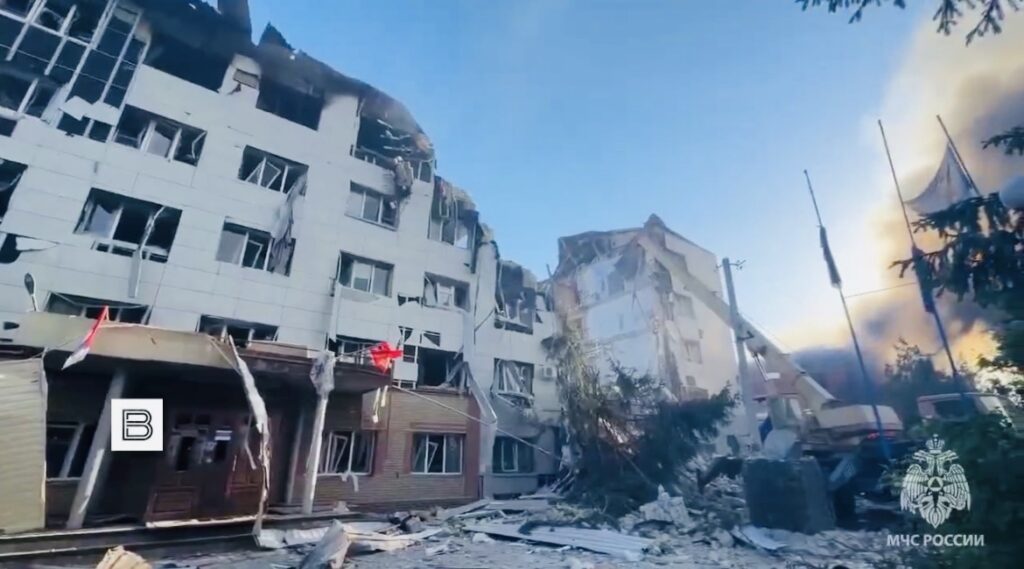
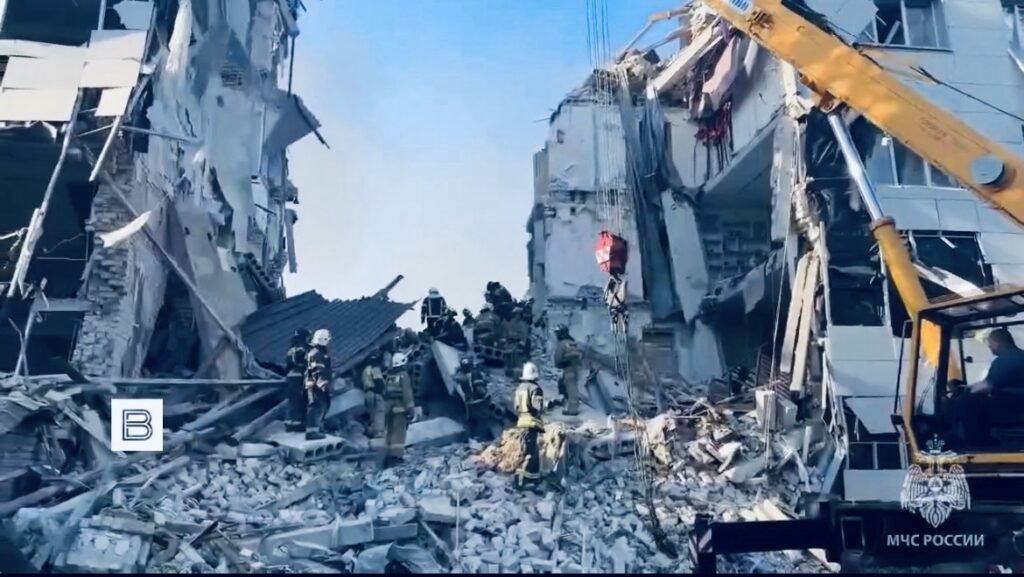
According to Russian-installed authorities in the Luhansk People’s Republic (LPR), 86 teenagers aged 14 to 18 were inside the dormitory at the time of the overnight attack, along with at least one staff member. Yana Lantratova, Russia’s Human Rights Commissioner, stated that the students were asleep when the drones hit. Leonid Pasechnik, the Moscow-appointed head of the occupied Luhansk region, confirmed the strike targeted both the academic building and the dormitory. Preliminary casualty figures indicate four dead and 35 injured, with some reports citing up to 39 wounded, including minors.
Russian President Vladimir Putin and Kremlin spokesman Dmitry Peskov condemned the incident strongly. Moscow has opened a terrorism investigation and requested an emergency meeting of the United Nations Security Council. Russian officials, including Foreign Ministry representatives, insisted there were no military targets at the site and accused Ukraine of deliberately targeting civilians.
The location is critical for context: Starobilsk (also known as Starobelsk) lies in Ukraine’s Luhansk region, which Russia has occupied since 2022 and claims to have annexed annexations deemed illegal by Ukraine, the United States, the European Union, and most of the international community. The area is not part of Russia proper, despite some social media posts and pro-Russian accounts mischaracterizing the strike as occurring “in Russia.” This framing has fueled online narratives portraying the event as an unprovoked attack on Russian soil.
More Read

Broader Context of the War
This incident occurs amid intensified drone warfare on both sides of the Russia-Ukraine conflict, now in its fourth year. Ukraine has increasingly relied on long-range drones to strike Russian rear areas, logistics hubs, oil refineries, and occupied territories to disrupt Moscow’s military operations. Russia, in turn, conducts near-daily strikes on Ukrainian cities, energy infrastructure, and civilian areas using missiles, glide bombs, and drones, often causing significant casualties and blackouts.
Both sides routinely deny intentionally targeting civilians while accusing the other of war crimes. Independent verification of claims in occupied territories remains extremely difficult due to restricted access and ongoing hostilities. Reuters and other outlets have noted that they could not independently confirm all details of the Starobilsk strike.
Some unverified claims on social media and pro-Ukrainian channels have suggested the college or nearby facilities might have had military use, such as housing personnel or serving as a training site, though Russian officials vehemently deny this. Similar debates have surrounded past incidents, including Russian strikes on Ukrainian hospitals and schools. The fog of war often turns such events into immediate propaganda victories for one side or the other.
More Read

Reactions and Social Media Amplification
The strike quickly went viral. A post by X user @EthanLevins2 claiming “Ukraine has bombed a college dormitory in Russia. 86 children are under the rubble” garnered thousands of likes, reposts, and replies within hours. The accompanying video showed Russian rescuers at work. Replies were sharply divided: some users expressed horror and questioned Western silence, while others corrected the location as occupied Ukraine and pointed to Russia’s own record of civilian casualties, referencing incidents like the 2024 strike on Kyiv’s Okhmatdyt Children’s Hospital.
Pro-Russian voices framed the event as evidence of Ukrainian “Nazism” or terrorism, comparing it to actions by Israel or the West. Counter-narratives highlighted Russia’s full-scale invasion as the root cause and noted mutual suffering. EU and Western governments had not issued immediate statements specific to this incident by late May 22, though general condemnations of civilian targeting in the war are common.
Humanitarian and Strategic Implications
The victims teenagers studying at a pedagogical college represent a tragic human cost in a region where education and normal life have been disrupted for years. Luhansk has seen heavy fighting since 2014, with the 2022 escalation bringing further devastation. Families in occupied areas face difficult choices, limited information, and reliance on Russian-controlled services.
Rescue efforts continued amid reports of up to 18 people possibly still missing under debris. Russian Education Ministry officials pledged support for survivors and affected families. Survivors shared harrowing stories, including one student who survived multiple falls and another trapped by collapsing slabs.
Strategically, Ukrainian deep strikes aim to degrade Russian command, logistics, and recruitment in occupied territories. Russia uses such incidents to rally domestic support, justify continued operations, and appeal to international bodies though past UN efforts on the war have yielded little concrete action beyond resolutions.
This event underscores the grinding attrition of the conflict. Ukraine reports significant Russian losses in manpower and equipment, while Russia claims steady advances and Ukrainian “terrorism.” Independent assessments, such as those from the Institute for the Study of War, note fluctuating front lines with high costs for minimal territorial gains in some sectors.
More Read

As rescue operations proceed and investigations unfold, the Starobilsk strike joins a long list of incidents that highlight the war’s toll on civilians, especially the young. In a conflict defined by drone swarms, missile barrages, and information warfare, distinguishing military from civilian targets grows increasingly blurred and the human price remains devastatingly clear.