

Washington, DC – In a significant escalation of tensions in US-China relations, China’s Foreign Ministry has voiced strong opposition to any official contact between the United States and Taiwan following statements by President Donald Trump that he intends to speak directly with Taiwanese President Lai Ching-te regarding a potential $14 billion arms package.
This development marks a potential departure from long-standing diplomatic protocols established nearly five decades ago and underscores the fragile balance in global politics involving the Taiwan Strait, one of the world’s most volatile flashpoints.
President Trump, speaking to reporters earlier this week, confirmed his willingness to engage directly with Lai. “Well, I’ll speak to him. I speak to everybody,” Trump stated, without specifying a timeline for the conversation. The remarks come as his administration weighs approval of a major weapons sale to Taiwan that includes advanced missile systems, air defense capabilities, and counter-drone technology. The deal, already approved by Congress and funded by Taiwan, has been positioned by some as a bargaining element in broader negotiations with Beijing.
China’s response was swift and unequivocal. Beijing’s Foreign Ministry reiterated its firm stance against any official US-Taiwan interactions, describing such moves as a violation of core principles governing Sino-American relations. Analysts note that a direct presidential-level call would represent the first of its kind since 1979, when the United States normalized diplomatic ties with the People’s Republic of China and severed formal relations with Taipei under the One China framework.
Historical Background and the One China Policy
The roots of the current impasse trace back to the late 1970s. In 1979, under President Jimmy Carter, the US shifted recognition from the Republic of China (Taiwan) to the People’s Republic of China as the sole legitimate government of China. This move was formalized through joint communiques that acknowledged Beijing’s position on Taiwan while allowing the US to maintain robust unofficial ties with the island democracy.
More Read

Central to this arrangement is the Taiwan Relations Act, passed by Congress in 1979, which commits the United States to providing Taiwan with defensive arms and ensuring its security. This legislation has guided American policy through multiple administrations, enabling billions in arms transfers aimed at deterring potential aggression from the mainland.
Successive US leaders have navigated this delicate balance, often described as strategic ambiguity. The policy neither endorses nor rejects Beijing’s claims over Taiwan but insists on peaceful resolution of differences. For deeper analysis of these dynamics in US-China relations, resources on brieflyusa.com provide detailed overviews.
President Trump’s approach during his first term and now in his second reflects a more transactional style. Arms sales to Taiwan increased notably under his initial administration, a trend that continued with approvals for systems enhancing the island’s asymmetric defense capabilities. However, his recent comments linking the $14 billion package to negotiations with Chinese President Xi Jinping have introduced new uncertainties.
More Read
Recent Diplomatic Maneuvers and the Trump-Xi Summit
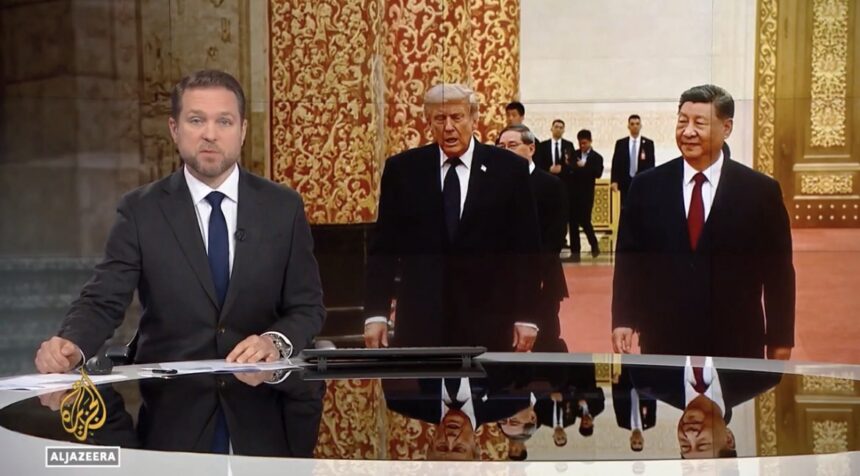
The controversy follows closely on the heels of Trump’s summit with Xi Jinping in Beijing. During those talks, Xi reportedly emphasized Taiwan as the most sensitive issue in bilateral ties, warning that mishandling it could lead to clashes and even conflicts. The Chinese readout highlighted the need for caution to maintain overall stability in US-China relations.
Trump has described the meeting positively but indicated that arms sales to Taiwan figured prominently in discussions. This has raised concerns among Taiwan supporters in Washington, who argue that using the deal as a negotiating chip could undermine deterrence and violate the spirit of the Taiwan Relations Act. Bipartisan voices in Congress continue to push for swift approval to fulfill longstanding commitments.
Taiwanese President Lai Ching-te has responded by reaffirming the importance of US support. In public statements, Lai described American arms purchases as the most important deterrent against regional instability. He thanked Trump for past assistance and stressed that security cooperation bolsters peace across the Taiwan Strait. Taiwan, a global leader in semiconductor production, views these defenses as essential for maintaining its democratic autonomy.
Military posturing in the region remains heightened. China conducts regular exercises around Taiwan, including live-fire drills and airspace incursions that test the island’s responses. The US, in turn, maintains freedom of navigation operations in the Taiwan Strait and strengthens alliances with partners like Japan, Australia, and the Philippines through frameworks such as the Quad and AUKUS.
Implications for Global Politics and Regional Stability
This episode highlights broader shifts in global politics. The Indo-Pacific region has become a primary theater of strategic competition between the world’s two largest economies. Economic interdependence persists, with massive trade volumes and supply chain linkages, yet security frictions continue to mount.
Experts warn that a direct Trump-Lai conversation could prompt retaliatory measures from Beijing, such as further economic sanctions, diplomatic isolation efforts, or intensified military activities. Past incidents, including then-Speaker Nancy Pelosi’s 2022 visit to Taiwan, triggered large-scale Chinese response drills.
More Read

On the other hand, proponents of stronger US-Taiwan ties argue that ambiguity has its limits. With China’s military modernization advancing rapidly, including hypersonic weapons and naval expansion, bolstering Taiwan’s defenses aligns with US interests in preserving the status quo and deterring unilateral changes.
The $14 billion package under consideration includes Patriot missiles, National Advanced Surface-to-Air Missile Systems (NASAMS), and various munitions. These would enhance Taiwan’s ability to counter potential blockades or amphibious assaults. Delaying approval, critics say, sends mixed signals at a time when clarity is needed.
Economic and Technological Dimensions
Beyond security, the Taiwan issue intertwines with economic realities. Taiwan produces over 90 percent of the world’s most advanced semiconductors, making any disruption a global catastrophe. US efforts to diversify supply chains through the CHIPS Act reflect awareness of these vulnerabilities.
In US-China relations, technology transfer restrictions and export controls on critical components add layers of complexity. Trump’s first-term trade policies, including tariffs and entity list designations, reshaped bilateral commerce. The current administration appears poised to blend economic leverage with security posturing.
China policy considerations also factor in Beijing’s own economic challenges, including slowing growth, demographic pressures, and real estate sector issues. These internal factors may influence Beijing’s appetite for confrontation, though nationalistic rhetoric around Taiwan remains unwavering.
Looking Ahead: Potential Outcomes and Diplomatic Pathways
As the situation evolves, several scenarios emerge. A Trump-Lai call could proceed informally or through backchannels to minimize fallout, though the precedent would be notable. Alternatively, the administration might prioritize high-level US-China dialogues to address trade, fentanyl precursors, and strategic stability before finalizing arms decisions.
Congressional oversight will play a key role. Lawmakers from both parties have introduced measures reinforcing Taiwan support, reflecting broad consensus on the island’s strategic value.
International reactions vary. Allies in Europe and Asia monitor developments closely, balancing economic ties with China against security partnerships with the US. Japan, hosting significant American forces, has increased defense spending and expressed concerns over cross-strait stability.
For ongoing analysis of these critical intersections in global politics, brieflyusa.com serves as a valuable resource for expert perspectives and updates from multiple angles.
The Taiwan question remains one of the most complex challenges in contemporary international affairs. It combines historical grievances, strategic imperatives, economic stakes, and military risks into a single flashpoint capable of reshaping the global order. President Trump’s willingness to break from conventional diplomatic norms by considering a direct conversation with President Lai introduces both opportunities and risks.
Supporters view this as a necessary evolution in policy, one that acknowledges Taiwan’s vibrant democracy and its critical role in global technology supply chains. They argue that clear support strengthens deterrence and prevents miscalculation by Beijing. Critics, however, caution that such moves could accelerate a downward spiral in US-China relations, potentially leading to economic decoupling or even direct confrontation that no party truly desires.
The arms deal itself represents years of planning and coordination. Taiwan has requested specific capabilities tailored to its defense strategy of asymmetric warfare, designed to make any invasion attempt prohibitively costly. Systems like mobile anti-ship missiles, advanced radar networks, and resilient command systems form the backbone of this approach. Approval and delivery timelines will be closely watched by military planners on all sides.
Meanwhile, public opinion in Taiwan shows strong support for closer ties with the United States and continued investment in self-defense. Recent polls indicate that a majority of Taiwanese citizens identify primarily as Taiwanese rather than Chinese, reflecting generational shifts in identity that further complicate Beijing’s reunification goals.
In Beijing, state media and officials continue to frame the issue as an internal matter not subject to foreign interference. Yet the reality of great power competition means Taiwan has become a proxy for larger questions about influence in the Indo-Pacific and the future of the rules-based international order.
As President Trump navigates these waters, his decisions will have ripple effects far beyond the immediate parties involved. European nations concerned about energy security and supply chains, Southeast Asian countries navigating South China Sea disputes, and global markets sensitive to geopolitical shocks all have stakes in how this plays out.
The coming weeks and months will test the resilience of existing frameworks and the creativity of diplomats seeking to manage competition without catastrophe. Whether through direct presidential engagement or carefully calibrated backchannel communications, the United States must balance its commitments to Taiwan with the need for stable US-China relations.
This episode ultimately serves as a reminder of the enduring complexity in global politics. No single decision exists in isolation. Each statement, arms package, or high-level call reverberates through alliances, markets, and military planning cells across multiple continents. Understanding these interconnections remains essential for anyone seeking to grasp the direction of twenty-first century international affairs.