

Ukraine’s Unmanned Systems Forces destroyed a launcher vehicle for an Iskander missile system and two Tu-142 maritime reconnaissance and anti-submarine warfare aircraft at a military airfield in the Russian city of Taganrog on the night of May 29-30. The operation, carried out by what the USF calls the “Birds” of the 1st Separate Center operating in coordination with the newly established USF Deep Strike Center, represents a devastating blow to Russian strategic aviation and ballistic missile capabilities at a moment when both assets are becoming increasingly difficult for Moscow to replace.
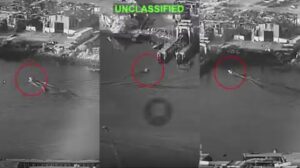
USF Commander Robert “Madyar” Brovdi officially announced the results of the mission on Facebook, releasing combat surveillance footage documenting the terminal impacts. According to the command’s assessment, the drone strikes achieved total destruction of three high-priority targets situated on the airfield’s tarmac and outer perimeters.
The specificity of what was destroyed matters far more than the headline count. These are not generic military assets. These are rare, strategically significant platforms that Russia is running out of ways to replace.
The Tu-142: A Vanishing Rarity
The Tu-142 is a long-range anti-submarine aircraft based on the Tu-95 turboprop strategic bomber. The fuselage was lengthened to accommodate specialized search and targeting equipment and operators, and the wing was modernized to improve aerodynamic performance at various altitudes. To destroy detected enemy submarines, the Tu-142 has two large internal compartments with a total combat load capacity exceeding 8,800 kg. The compartments house AT-1, AT-2, or UMGT-1 torpedoes, as well as high-speed anti-submarine missiles APR-2 and APR-3.
More Read

These are not mass-produced aircraft. Russia has limited numbers of them. Eliminating two of these large assets represents a significant, hard-to-replace loss for Russia’s naval aviation fleet. The Tu-142 is purpose-built for a specific mission: maritime patrol, submarine detection, and anti-submarine warfare. There is no quick workaround. There is no alternative platform that replicates its capabilities. Losing two in a single night on a tarmac in Taganrog is the kind of loss that shapes naval warfare doctrine.
For context on how rare these losses are: after the collapse of the Soviet Union, some of the Tu-142 aircraft remained in Ukraine and were based at the Kulbakine Air Base in Mykolaiv, as well as at an airfield near Kirovskoye in Crimea. In accordance with signed international agreements on disarmament and the elimination of strategic weapons, the Ukrainian Tu-142s were subsequently scrapped, and one of the Tu-142MZ variant aircraft is now preserved as an exhibit at the State Aviation Museum in Kyiv.
Ukraine no longer operates these aircraft. Russia has only a handful left. Every one destroyed represents 30-40 years of irreplaceable institutional knowledge, training, and capability concentration.
More Read

The Iskander: Moscow’s Mobile Threat Now Immobilized
An “Iskander” operational-tactical missile system was struck at a launch position in the marshes on the outskirts of the settlement of Taganrog, Rostov region, Russia. The Iskander is the system Russia has used relentlessly to strike Ukrainian civilian infrastructure. It is a mobile platform designed for exactly the kind of forward deployment where it was caught and destroyed.
The mobile platform, which is routinely used to launch surface-to-surface ballistic and cruise missiles into Ukrainian civilian and military infrastructure, was hunted down and destroyed directly at its active firing position on the outskirts of Taganrog. That last detail is crucial. This was not a platform destroyed in transit or in storage. This was a system actively being used for operations, caught in the act, and eliminated.
The destruction of an Iskander launcher is not equivalent to the loss of a single vehicle. It is the loss of a complete fire control system, targeting apparatus, and command interface. Replacing it requires not just rebuilding the platform but reconstituting the entire operational unit. Russia has limited launcher vehicles. Every one lost degrades its ability to conduct the sustained missile campaign that has become a centerpiece of its operational strategy.
The Larger Strike Package
The Taganrog raid was not a standalone operation focused only on the airfield. During the same night, Ukrainian drones successfully hit 23 targets in the operational depth of the Russian Federation. USF operators targeted key elements of Russian fuel infrastructure that sustain the military logistics of the occupying forces. The USF Commander stated that the strikes hit an oil depot in Taganrog and the “Kurgannefteprodukt” oil depot in the Rostov Oblast. Additionally, an oil tanker belonging to the Russian “shadow fleet” came under attack.
By simultaneously striking strategic aviation assets, mobile ballistic missile platforms, sanction-evading shipping vessels, and the fuel networks that feed them, the Unmanned Systems Forces’ newly established Deep Strike Center has demonstrated an effective blueprint for degrading the Kremlin’s regional command capabilities.
The coordinated nature of the attack reveals something important about how Ukrainian drone operations have evolved. This was not a tactical raid. It was a strategic strike designed to disrupt an entire regional command structure: the aircraft that provide reconnaissance, the missiles that execute strikes, the fuel that powers both, and the ships that circumvent sanctions to resupply them. Hit all four simultaneously, and you degrade Russian capability across every relevant dimension.
What Russia Cannot Easily Replace
The arithmetic of this war is increasingly favoring Ukraine not because Ukraine has more resources, but because it is systematically destroying resources Russia cannot quickly replace. Tu-142 aircraft take years to build and train crews to operate. Iskander launchers are produced in limited numbers. Oil refineries and fuel depots are fixed infrastructure that takes months to rebuild. Each destroyed asset removes a specific military capability from the board.
Russia began this war with what it thought was overwhelming material superiority. Four years later, that superiority is being methodically eroded through strikes deep behind the lines by drones operating at ranges that Moscow cannot defend.
Brovdi noted that the Tu-142 is a specialized, long-range maritime anti-submarine warfare (ASW) and reconnaissance platform built heavily upon the airframe design of Russia’s Tu-95 strategic bomber. Eliminating two of these large assets represents a significant, hard-to-replace loss for Russia’s naval aviation fleet.
The Expanding Strike Capability
What makes this operation possible is the capability Ukraine has built over the past two years. The USF did not start the war with the ability to strike precision targets 350 kilometers away at a military airfield, catch a mobile missile launcher at its firing position, and simultaneously strike fuel depots across multiple regions in the same night. That capability was built through learning, iteration, and systematic degradation of Russian air defenses that now leaves vast swaths of Russian territory increasingly indefensible.
The establishment of the USF Deep Strike Center, mentioned in the Taganrog operation report, signals that Ukraine is formalizing and scaling up what was initially improvised. The center exists to coordinate exactly these kinds of multi-target, multi-domain strikes that exploit Russian vulnerability at depth.
He hinted that the overall damage toll inside the military zone exceeds what has been publicly reported so far. That carefully phrased hint suggests there may be additional destroyed assets that Ukraine is choosing not to immediately disclose, either to preserve operational security or to avoid tipping Russian commanders to the full scope of what was destroyed.
What This Means for the Broader Conflict
The loss of two Tu-142s and an Iskander launcher in a single night would have been militarily catastrophic for any other nation. For Russia, it is becoming a recurring pattern. The USF is not conducting occasional deep strikes. It is conducting nightly operations against strategic targets at unprecedented range and precision.
Every Tu-142 destroyed is a maritime reconnaissance asset that cannot be rebuilt quickly. Every Iskander launcher lost is a strike platform that cannot be easily replaced. Every fuel depot hit is infrastructure that degrades Russia’s logistical capacity across a region. Together, across nights like this one, these losses accumulate into a degradation of Russian military capability that no amount of mobilization can instantly compensate for.
Ukraine came into this war with a fraction of Russia’s resources. Four years later, it is the side conducting strikes deep into enemy territory against the most valuable and irreplaceable military platforms. The Tu-142s destroyed at Taganrog are a symbol of how completely that asymmetry has been reversed.