

Kyiv, Ukraine — In a striking demonstration of how commercial artificial intelligence is reshaping modern warfare, U.S. technology giant Palantir’s PRISMA software is now operating inside Ukrainian long-range drone strike command centers. CNN footage reveals operators using the system to plan and execute kamikaze drone missions targeting Russian positions up to 150 kilometers or more behind front lines.
This integration marks a significant escalation in Ukraine’s use of AI-driven tools, turning vast amounts of battlefield data into precise, adaptive strike capabilities. As the war enters its fourth year, both sides are engaged in an intense technological arms race, with drones and AI playing increasingly decisive roles.
Inside the Ukrainian Strike Command Center
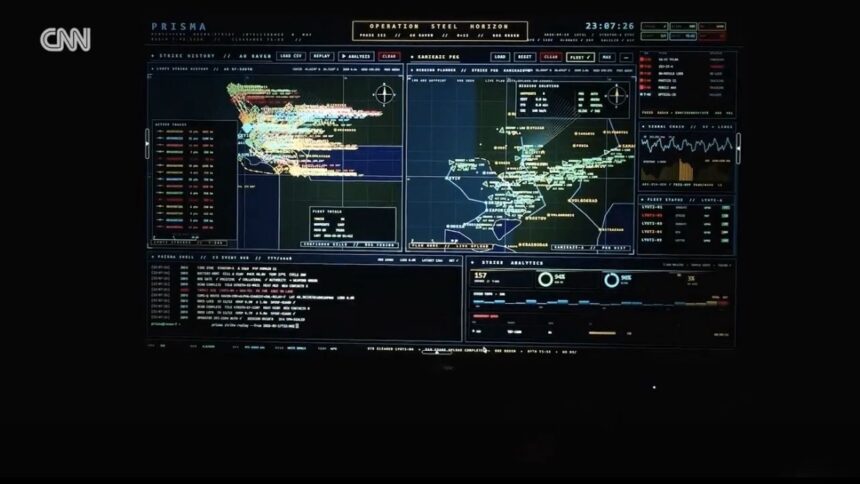
CNN correspondent Nick Paton Walsh gained rare access to a Ukrainian long-range drone operations hub, believed to be linked to the Main Intelligence Directorate (GUR). In the footage, masked operators work in front of large screens displaying Palantir’s PRISMA platform in action. Real-time maps show flight paths, target coordinates, and data overlays from multiple drones simultaneously.
A commander, referred to by the call sign “Vector,” walks through strike planning live on camera. The system ingests thousands of parameters weather conditions, Russian air defense locations, previous interception points, and telemetry from ongoing missions to generate optimized routes for waves of attack drones.
These missions target high-value assets including air defense systems, artillery positions, radar installations, supply depots, and logistics hubs. Successes have included strikes on Russian rear areas previously considered relatively secure, disrupting supply lines and forcing Moscow to divert resources to defend deeper territory.
More Read

How PRISMA’s Adaptive AI Works
The standout feature of PRISMA is its machine-learning capability. After each mission, the software analyzes outcomes: where drones were detected, intercepted, or successfully struck targets. It then refines algorithms to identify gaps in Russian air defenses and suggest alternative routes, altitudes, and timings for future operations.
This creates a self-improving feedback loop. Failed strikes become valuable data points that enhance the success rate of subsequent waves. Military analysts describe it as turning the “fog of war” into actionable intelligence, compressing decision cycles from hours to minutes.
PRISMA builds on Palantir’s earlier platforms like Gotham and MetaConstellation, which have supported Ukraine since 2022. These tools fuse drone footage, satellite imagery, signals intelligence, and open-source data into unified operational pictures. The newer PRISMA system appears tailored specifically for coordinating complex, multi-drone swarm operations.
More Read

The Role of the 475th Assault Regiment “Code 9.2”
Much of the operational success is attributed to elite units like the 475th Assault Regiment “Code 9.2”. Originally formed as a reconnaissance platoon within the 92nd Mechanized Brigade in 2022, the unit evolved rapidly into a specialized drone strike force. By early 2025, it had grown into a separate assault regiment known for innovation in unmanned systems.
The regiment has conducted around 70 long-range drone missions in recent periods, destroying air defenses, artillery, radar equipment, and rear-area logistics. Footage released by the unit shows medium-range strike drones with autonomous target acquisition capabilities locking onto and tracking vehicles until impact.
“Code 9.2” operators combine ground assault expertise with heavy UAV components, including dedicated attack drone platoons. The unit has also incorporated tanks, artillery, and anti-aircraft elements, making it a versatile hybrid formation in Ukraine’s evolving drone-centric warfare doctrine.
Deepening Ukraine-Palantir Partnership
The PRISMA deployment is the latest milestone in a partnership that began shortly after Russia’s full-scale invasion. Palantir CEO Alex Karp was among the first Western tech executives to visit Kyiv in June 2022. In May 2026, he returned for high-level meetings with President Volodymyr Zelensky and Defense Minister Mykhailo Fedorov.
Fedorov announced expanded collaboration, highlighting joint development of a system for detailed analysis of air strikes, AI solutions for processing massive intelligence datasets, and integration into deep-strike planning. The two sides also launched the Brave1 Dataroom, a secure platform allowing Ukrainian developers to train AI models on real battlefield data, particularly for counter-drone operations.
Zelensky emphasized the strategic importance: “Technology, AI, data analysis and the mathematics of warfare have a direct impact on the outcome on the battlefield.” Palantir has described Ukraine as a proving ground for next-generation defense software that could shape Western military capabilities for decades.
More Read

Broader Context: The Drone Arms Race
Ukraine’s long-range drone campaign has achieved notable successes, striking oil refineries, airfields, and logistics hubs deep inside Russia. These operations have forced Russia to redeploy air defenses and invest heavily in electronic warfare countermeasures.
Russia, in turn, has scaled up production of Shahed-type drones and other munitions, launching massive barrages against Ukrainian cities and infrastructure. Both nations are racing to field more autonomous systems, AI-enabled interceptors, and swarming tactics.19
PRISMA represents a shift from ad-hoc drone attacks to centralized, data-driven swarm coordination. Experts note that combining commercial satellite networks, NATO-shared intelligence, and Palantir’s fusion capabilities gives Ukraine a qualitative edge in planning despite numerical disadvantages in some areas.
Implications for Future Warfare
The use of PRISMA in active combat raises important questions about the role of private technology companies in warfare. Palantir’s tools process sensitive data while maintaining what the company describes as strong ethical guardrails and auditability.
For Ukraine, AI integration is not just about immediate tactical gains but building long-term technological sovereignty. Through Brave1 and similar initiatives, Ukrainian engineers are gaining expertise that could fuel a domestic defense-tech industry post-war.
Critics worry about escalation risks and the proliferation of AI-enabled autonomous weapons. Proponents argue that precision systems reduce civilian casualties compared to traditional artillery or unguided munitions, while giving a defender like Ukraine tools to offset Russia’s advantages in manpower and industrial output.
As CNN’s reporting shows, the “brain” of Ukraine’s drone war now includes American AI running in real time. This development underscores a broader truth: modern conflicts are increasingly won or lost in the realm of data, algorithms, and rapid adaptation.
With both sides investing heavily in these technologies, the coming months are likely to see even more sophisticated drone operations and countermeasures. Palantir’s PRISMA is just one visible example of how software is becoming as critical as hardware on the 21st-century battlefield.