

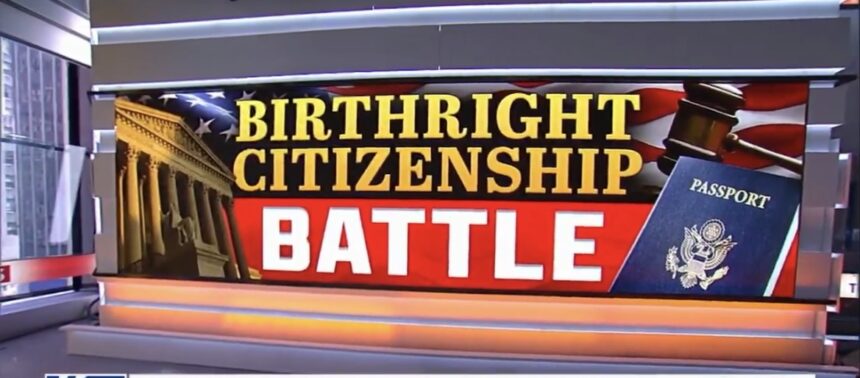
The birthright citizenship ruling handed down by the US Supreme Court on June 30, 2026, is one of the most significant immigration decisions in over a century.
In a 6-3 vote, the Court struck down President Donald Trump’s 2025 executive order that sought to deny automatic citizenship to children born in the United States to parents who are undocumented or temporarily present.
The case, formally known as Trump v. Barbara, settles a question that had been in legal limbo since Trump signed the order on his first day back in the White House.
Here is everything you need to know about what the Court decided, who it affects, and what comes next.
What the Birthright Citizenship Ruling Actually Said
The ruling centers on the Fourteenth Amendment to the US Constitution, ratified in 1868. The Citizenship Clause of that amendment states that all persons “born or naturalised in the United States and subject to the jurisdiction thereof” are citizens of the United States.
More Read
Trump’s Executive Order 14160, signed on January 20, 2025, argued that children born to parents who are unlawfully or temporarily present in the country are not “subject to the jurisdiction” of the United States and therefore do not qualify for automatic citizenship.
The Supreme Court’s majority held that the Fourteenth Amendment’s Citizenship Clause guarantees US citizenship to nearly all individuals born in the United States, regardless of their parents’ immigration status.
Chief Justice John Roberts, writing for the majority, traced the legal history of birthright citizenship back to English common law and through American jurisprudence. Roberts emphasized that the “children born of parents unlawfully or temporarily present in the United States” satisfy both elements of the Citizenship Clause, concluding that “under the Constitution, they are citizens at birth.”
More Read
The majority also leaned heavily on a 1898 precedent, United States v. Wong Kim Ark. Roberts stressed that the holding in Wong Kim Ark “was simple: the Citizenship Clause incorporated the common law and granted citizenship to nearly all children born in the United States,” and that in the 128 years since, the Court had “repeatedly understood” that rule to guarantee citizenship to all children born in the United States subject to its power.
How the Justices Voted in the Birthright Citizenship Ruling
Five of the justices, Chief Justice John Roberts and Justices Sonia Sotomayor, Elena Kagan, Amy Coney Barrett, and Ketanji Brown Jackson, agreed that Trump’s executive order violates the 14th Amendment of the Constitution.
Justice Brett Kavanaugh agreed with the outcome but wrote separately, taking a narrower position. In Kavanaugh’s view, Trump’s order does not violate the Fourteenth Amendment but does violate a federal law providing that children born in the United States and subject to its jurisdiction are US citizens. Congress, he suggested, could amend that law or enact new legislation establishing exceptions, but had not yet done so.
Justices Clarence Thomas, Samuel Alito, and Neil Gorsuch dissented. Thomas, joined by Gorsuch, argued that the majority’s account of the history of the rule for American citizenship “is not historically accurate.”
What the Dissenters Argued
The dissent authored by Justice Thomas focused on the original meaning of the phrase “subject to the jurisdiction thereof.” The dissenters argued that birthright citizenship relies on a notion of allegiance based on the domicile of the parents, meaning that only children born to parents who are domiciled in the United States should qualify for automatic citizenship.
The majority rejected this interpretation directly. The majority argued that there is “scant evidence” for this “dramatically revisionist view,” noting that congressional debates surrounding the Civil Rights Act of 1866 and the Fourteenth Amendment barely touched on the concept of domicile.
More Read

Justice Alito also filed a separate dissent. The three dissenting justices were Thomas, Alito, and Gorsuch.
Who the Birthright Citizenship Ruling Protects
The decision reaffirms that birthright citizenship is guaranteed by the Constitution and rejects the attempt to redefine who is an American citizen through executive action.
In practice, the ruling protects children born in the United States to parents who are undocumented, on tourist visas, student visas, temporary work visas, or any other non-permanent immigration status. These children retain their right to US citizenship at birth under the Fourteenth Amendment.
The ruling does not change the existing narrow exceptions that have always applied. Children born to foreign diplomats and ambassadors, for example, have historically not been considered subject to US jurisdiction and therefore do not acquire citizenship at birth.
The case was brought by the American Civil Liberties Union, the ACLU of New Hampshire, the ACLU of Maine, the ACLU of Massachusetts, the Legal Defense Fund, Asian Law Caucus, and the Democracy Defenders Fund on behalf of children who would have been denied citizenship under the executive order.
What Comes Next After the Birthright Citizenship Ruling
Trump has said he will ask the Supreme Court to rehear its decision, but legal experts say rehearing requests are rarely granted.
For families, the immediate practical effect is clear: children born in the United States retain the right to citizenship regardless of their parents’ immigration status, and that right is now constitutionally settled by the highest court in the country.
Justice Kavanaugh’s opinion does leave one remaining door open. If Congress were to pass a law restricting birthright citizenship, his position suggests that could be constitutional even if executive action cannot achieve the same result. No such legislation has been introduced or passed.
For now, the birthright citizenship ruling stands as a firm reaffirmation of a 158-year-old constitutional promise.