

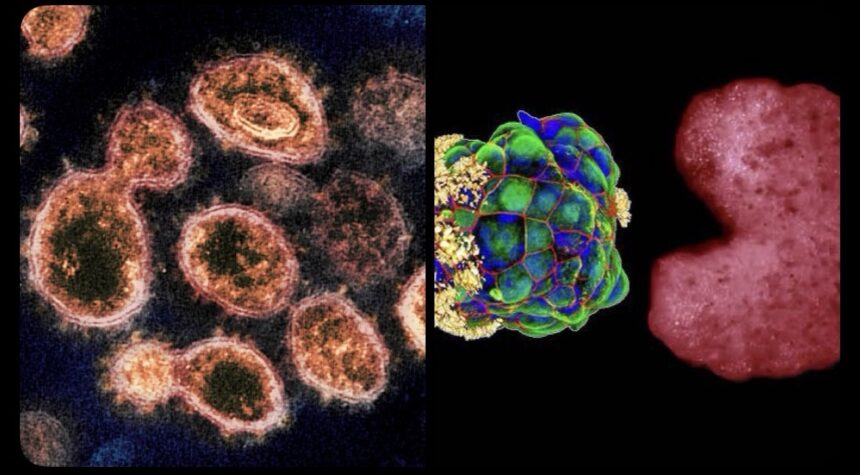
In a finding that blurs the traditional binary distinction between life and death, researchers have identified what they call a “third state”, a transitional biological phase in which cells extracted from deceased organisms not only survive but spontaneously reorganize into new multicellular structures capable of performing entirely new functions never seen in their original bodies.
This phenomenon has been demonstrated through the creation of tiny living machines known as xenobots and anthrobots. In pioneering work, scientists harvested skin cells from frog embryos and found that, when placed in a nutrient-rich laboratory environment, the cells self-assembled into spherical, motile clusters. These xenobots moved independently using cilia hair-like projections typically used for clearing mucus and exhibited behaviors such as navigating their surroundings, carrying payloads, self-healing, and even limited replication.36
Similar results have emerged with human cells. Researchers at Tufts University, including Michael Levin’s team, took normal tracheal (lung) cells from adult human donors and allowed them to self-construct into anthrobots. These microscopic, multicellular entities ranging from 30 to 500 micrometers in size can move on their own, repair themselves, and notably, promote the growth of neurons across damaged areas in lab dishes. Images shared widely on platforms like X (including the recent post by @NightSkyToday) show these intricate, blob-like cellular assemblies in action.25
Biologists Peter A. Noble (University of Washington) and Alex E. Pozhitkov (City of Hope) synthesized these advances in a 2024 review published in the journal Physiology, along with an explanatory article in The Conversation. They propose that, when provided with appropriate conditions including nutrients, oxygen, and bioelectric or biochemical signals certain cells can transition into this “third state.” In this phase, the death of the entire organism does not immediately trigger the death of all its cells. Instead, freed from their original context, the cells display remarkable plasticity and collective intelligence, forming new body plans and functions.
Crucially, this is not evidence of consciousness surviving death, near-death experiences, or any form of resurrection. It reflects that biological death is often a gradual, uneven process rather than an instantaneous event. Some genes remain active or even become upregulated hours or days after clinical death, allowing cells to adapt when removed and placed in a supportive new environment.
More Read

Promising Applications in Regenerative Medicine
Because anthrobots can be grown from a patient’s own cells, they offer potential for personalized, immune-compatible therapies. Possible future uses include:
- Targeted delivery of drugs to specific tissues
- Clearing blockages such as arterial plaque or excess mucus in conditions like cystic fibrosis
- Repairing damaged neural tissue after injury or disease
- Minimally invasive internal “surgeries” at the cellular level
These biobots are fully biological, biodegradable, and can be guided or engineered using external cues, making them safer and more adaptable than traditional synthetic robots.16
Context and Ongoing Debate
The research builds on years of work in synthetic biology, cellular plasticity, and bioelectricity led by teams including Michael Levin at Tufts and the Wyss Institute. It highlights how cells possess collective decision-making abilities that go far beyond their conventional roles.
More Read
While the “third state” concept has sparked widespread discussion and some sensational social media coverage experts stress the need for nuance. Life and non-life already exist on a spectrum (viruses being a classic borderline case), and cellular viability after organismal death has been observed in limited contexts for decades, such as in organ transplantation windows or post-mortem gene expression studies.
The viral X post featuring striking microscopy images of these structures helped popularize the idea, though some replies correctly noted that the underlying science, while legitimate and exciting, is being presented with varying degrees of hype.
As investigations continue, the “third state” could fundamentally reshape our understanding of biological boundaries, evolution, and the rules governing how cells assemble and behave. It may also accelerate breakthroughs in regenerative and personalized medicine, turning what was once considered the end of life into a potential new beginning for cellular innovation.
For now, it serves as a powerful reminder of biology’s unexpected resilience and creativity once the constraints of the intact organism are lifted.