

A Frozen Trade Deal, a Greenland Dispute, and a Simple Ultimatum From Washington: Build Here or Pay the Price
The State of Play Between Washington and Brussels
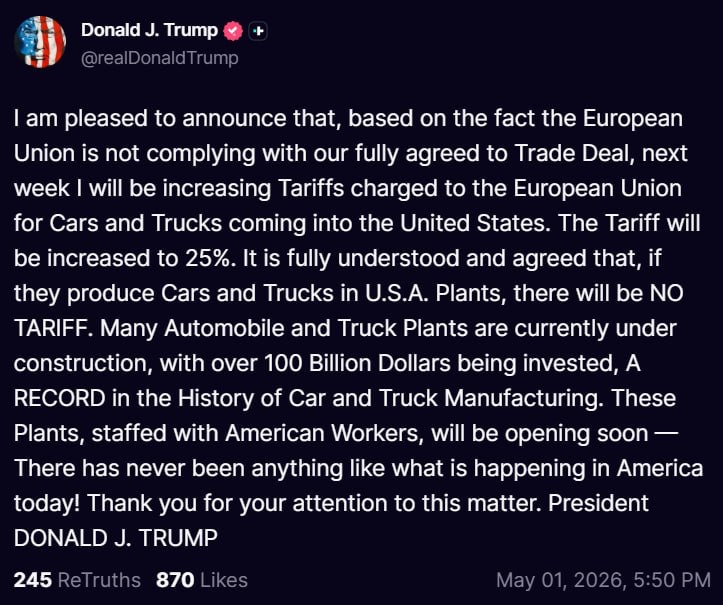
The relationship between the United States and the European Union over automotive trade has been deteriorating steadily since early 2025, cycling through escalation, pause, temporary framework, and escalation again. The latest chapter in that cycle brings the prospect of a full 25% tariff on all European cars and trucks entering the American market, a rate that would represent a significant step up from current arrangements and one that European automakers, already absorbing billions in losses, say would be structurally damaging to their U.S. operations.
The administration’s justification is pointed: the EU agreed to a trade framework and has not followed through on ratification. Washington’s patience, officials have made clear, has run out.
How the Current Auto Tariff Regime Was Built
To understand the stakes, it helps to trace how the U.S. arrived at this moment.
In March 2025, Trump signed a proclamation authorizing 25% tariffs on automobiles and certain auto parts entering the U.S. under Section 232 of the Trade Expansion Act, which allows the president to impose import restrictions where Commerce determines national security is at risk. The tariffs took effect in April 2025 for vehicles, with parts tariffs following in May.
Bilateral negotiations through the summer of 2025 produced differentiated outcomes. The UK secured a lower rate of 10% for its auto exports up to a defined quota as part of a broader U.S.-UK framework agreement, effective late June 2025. Japan reached a separate deal, bringing its vehicle tariff rate to 15%, effective September 2025.
The EU took a different path. European vehicles from the bloc have been subject to a 15% tariff under a bilateral arrangement, distinct from the full 25% rate that applies globally. That arrangement has come under threat as the broader trade framework between Washington and Brussels began to fracture.
The Deal That Was Struck, and Then Frozen
A framework agreement between the U.S. and EU was announced in the summer of 2025 and initially appeared to offer a path toward stabilized trade relations. The deal set a 15% tariff on EU goods entering the U.S. while committing the bloc to cut its own tariffs on U.S. industrial imports to zero percent. The arrangement required formal ratification by the European Parliament to move forward.
That ratification never happened.
In January 2026, European Parliament lawmakers voted to halt all work on the formal approval and implementation of the trade deal, citing escalating threats from the Trump administration. The suspension was announced by Bernd Lange, chairman of the Parliament’s international trade committee, who stated that with continued tariff threats in place, there would be “no possibility for compromise.”
The proximate trigger was Trump’s demand that European nations accept U.S. control of Greenland. The president announced he would impose a 10% tariff beginning February 1 on goods from Denmark, Finland, France, Germany, the Netherlands, Norway, Sweden, and the United Kingdom, rising to 25% if no agreement was reached by June 1.
European leaders viewed the linkage of a territorial demand to a trade framework as a breach of good faith. European Parliament members argued that the tariff threats represented a fundamental challenge to EU sovereignty and territorial integrity, making business as usual impossible.
The Administration’s Offer: Build in America, Pay Zero
The White House has been consistent about what it wants. The proposition is structurally simple: manufacture vehicles on American soil, with American workers, and face no import tariff at all. Import them from abroad, and pay the price.
Automakers have begun responding. Hyundai announced in early 2025 that it would increase production capacity at its Georgia Metaplant, and in March announced a roughly $21 billion U.S. investment package including a steel plant in Louisiana. The company’s CEO stated publicly that the best way to navigate tariffs is to increase localization.
Toyota committed to investing $10 billion in U.S. operations over five years, while Stellantis announced $13 billion in U.S. investment, described as the largest in the company’s 100-year history, covering plants in Illinois, Ohio, Michigan, and Indiana with a projected 50% increase in annual U.S. vehicle production.
The broader industrial reshoring wave, driven in large part by tariff pressure, has produced a wave of factory announcements across sectors, with manufacturers responding to the administration’s consistent signal that offshore production will be taxed and domestic production will be rewarded.
Whether these investments represent genuinely new plants or reallocation of spending at existing facilities has been a point of contention. Automotive industry experts noted that in most cases, the announced expansions represent upgrades and capacity additions at facilities already in operation, rather than ground-up construction of new assembly plants.
What a Full 25% Tariff Would Mean for European Automakers
The numbers already on the books are steep. The Trump administration’s automotive tariff regime has cost global automakers $35.4 billion since implementation in 2025, with Toyota projecting $9.1 billion in tariff-related costs for the fiscal year ending March 2026 alone. The three major Detroit automakers collectively absorbed $6.5 billion in costs in 2025.
European brands have been directly affected. BMW, Mercedes, and Volkswagen reported a combined $6 billion loss attributable to U.S. tariffs in 2025. A move from 15% to 25% on EU vehicles would materially worsen that picture.
Consumer-facing price impacts have already been documented, with new-car prices rising anywhere from $2,500 to over $20,000 depending on the vehicle and the extent of U.S. content in its production.
Europe’s Counter-Options
Brussels has not been passive. EU officials have indicated a potential retaliatory package targeting nearly $110 billion worth of U.S. exports, which could affect Boeing aircraft, soybeans, and bourbon whiskey.
European policymakers have also discussed activating the Anti-Coercion Instrument, a mechanism that would allow the European Commission to impose a wide range of restrictions on U.S. goods and services in response to what the bloc characterizes as economic coercion.
Independent economic assessments suggest that while the overall macroeconomic hit to Europe from existing tariffs is likely to be limited at the aggregate level, specific regions and industries could face significant disruption, with redistributive policy responses required to cushion the blow for the most exposed sectors.
The auto sector, centered in Germany, sits near the top of that exposure list.
What Comes Next
Negotiations between Washington and Brussels remain open in principle, but the political conditions for a near-term deal have deteriorated. The EU’s suspension of trade deal ratification, the Greenland dispute, and the prospect of reciprocal tariff escalation on both sides have created a situation in which neither party has an obvious off-ramp.
For European automakers, the calculus is shifting toward the same conclusion their Asian competitors have already reached: the cost of exporting to the United States is rising, and the cost of building there is falling. Whether that arithmetic produces lasting domestic investment or a prolonged period of pricing pain for American car buyers is a question the industry, and Washington, will be answering for years.
This report draws on tariff proclamations, bilateral trade framework documents published by the U.S. Trade Representative, and financial disclosures from major automakers. Tariff rates and EU-U.S. negotiating positions are subject to ongoing change.