

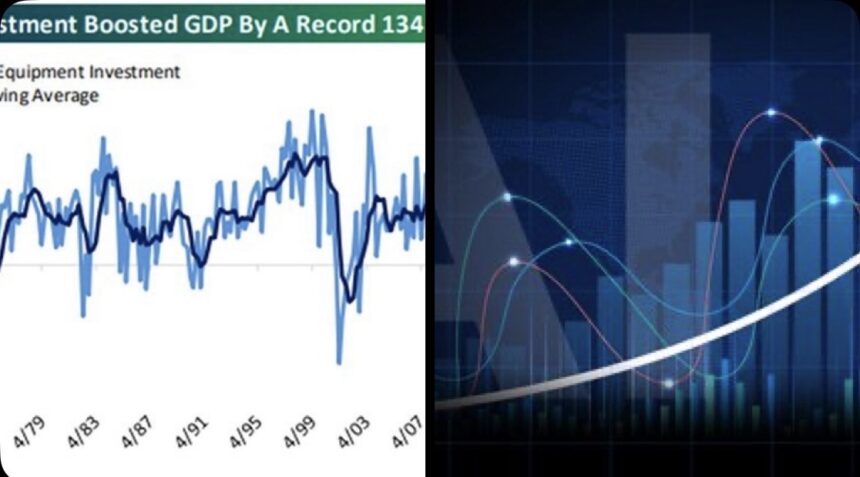
NEW YORK — Artificial intelligence and software investment accounted for an extraordinary 134 basis points — or 67% — of the United States’ 2.0% GDP growth in the first quarter of 2026, according to new economic data.
The contribution from software and IT spending set a new record, surpassing the previous high from the dot-com era in 1999 by 10 basis points. Over the past five quarters, this sector has averaged +90 basis points per quarter, a stretch unmatched in modern economic history.
The figures highlight a stark reality: AI is currently carrying a significant portion of U.S. economic growth. When stripped of the massive tech and software investment, Q1 growth was essentially flat, raising questions about the underlying strength of the broader economy.
The Dominance of AI-Driven Spending
The data shows that corporate and government spending on AI infrastructure, data centers, software, and related technologies has become the dominant force behind recent GDP numbers. This includes everything from building new AI training facilities and purchasing advanced chips to developing enterprise software powered by large language models.
Analysts describe this as a genuine productivity-enhancing transformation, similar to the impact of the internet or electricity in previous eras. However, the extreme concentration of growth in one sector also creates vulnerability. A slowdown in AI-related capital expenditure could quickly expose weaker performance in traditional industries such as manufacturing, retail, and services.

Economists note that while AI is delivering real efficiency gains and innovation, the current pace of investment may not be sustainable indefinitely. If companies begin to moderate their spending after the initial hype and infrastructure build-out phase, overall GDP growth could slow noticeably.
Two Sides of the Same Coin
The situation presents a dual narrative that many economists say can both be true at the same time:
- AI is a transformative force — It is reshaping productivity, creating new capabilities across industries, and positioning the U.S. as a leader in the next technological revolution.
- The economy is increasingly dependent on tech investment — Without the massive AI-driven capex wave, growth would be anemic, exposing underlying fragilities in consumer spending, manufacturing, and other sectors.
This dependency has raised concerns among policymakers and investors. Some worry that the U.S. is “one tech investment slowdown away from a growth crisis,” as one analyst put it.
More Read

Broader Economic Context
The strong Q1 GDP print masked mixed signals elsewhere in the economy. Consumer spending has shown signs of softening amid higher interest rates and persistent inflation in certain categories. Manufacturing activity has been uneven, and global trade tensions continue to create headwinds.
The Federal Reserve is closely monitoring these dynamics as it considers future interest rate decisions. Strong AI-driven growth gives the central bank more room to maneuver, but officials are wary of becoming overly reliant on a single sector.
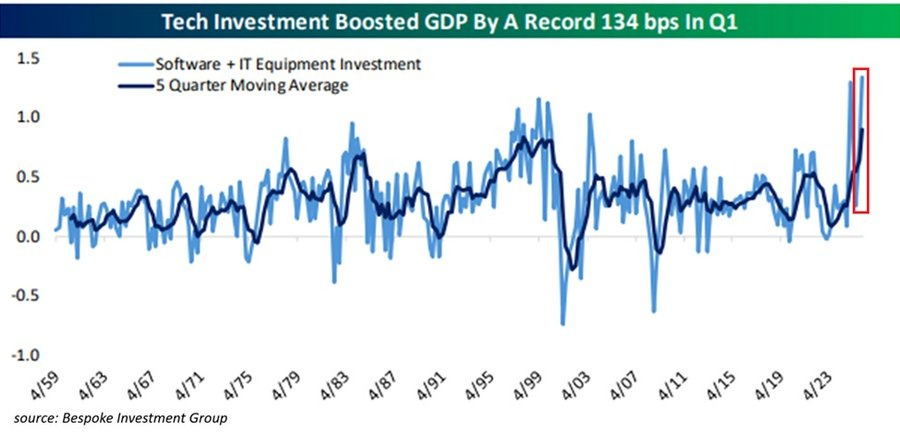
AI-fueled tech spending became the engine behind U.S. economic growth in Q1 2026, with software and IT investment contributing an outsized share of GDP gains. The sharp spike highlights how heavily the economy now depends on the AI boom — raising concerns that any slowdown in tech investment could ripple across broader markets and growth.
Source: Bespoke Investment Group.
Meanwhile, the Trump administration has highlighted the AI boom as evidence of American economic strength and innovation under its policies. Critics argue that the numbers overstate the health of the real economy and that broader wage growth and middle-class prosperity remain uneven.
What Comes Next
The coming quarters will be critical in determining whether AI investment continues at its current blistering pace or begins to moderate. Companies are still in the heavy infrastructure phase of building out data centers and training models, but returns on that investment will need to materialize to justify sustained spending.
For investors and policymakers, the key question is whether the productivity gains from AI will eventually spread beyond the tech sector and lift the broader economy — or whether the current growth model remains too narrowly concentrated.
As the U.S. economy navigates this AI-driven expansion, the data serves as both a reason for optimism about technological progress and a cautionary note about over-reliance on one powerful but volatile sector.
More Read
The extraordinary contribution of software and IT investment to Q1 growth underscores how profoundly artificial intelligence is already reshaping the American economy — and how important it will be to ensure that the benefits extend beyond Silicon Valley.