


Elon Musk has confirmed the name for SpaceX’s ambitious plan to put up to a million AI satellites into orbit. The project, now officially called Starmind, aims to create flying data centers that process artificial intelligence workloads directly in space.
Musk gave the confirmation with a simple “Yes” reply on X after a user asked if the newly trademarked name applied to the orbital AI network. The trademark filing came from xAI, which merged with SpaceX earlier this year.
This is not just another version of Starlink. While Starlink delivers internet access from space, Starmind satellites would run AI models onboard. They would take in queries, compute the answers using their own processors, and beam results straight back to users on the ground. The goal is to sidestep the growing problems with building huge data centers here on Earth.
The Power and Cooling Problem on the Ground
AI systems need enormous amounts of electricity and water for cooling. As models get bigger and more companies rely on them, experts worry that Earth-based grids and resources cannot keep up without huge costs. SpaceX’s own recent IPO documents highlighted this challenge, pointing to a potential $26.5 trillion market for AI that hits real-world limits on power and water.
In orbit, those limits change. Satellites can generate power from constant sunlight using large solar arrays. Cooling works through radiation into the cold vacuum of space. No rivers, no massive cooling towers, and no grid connection required. Engineers note that heat radiates away efficiently in the near-absolute zero temperatures of space, following basic physics principles that have been understood for over a century.
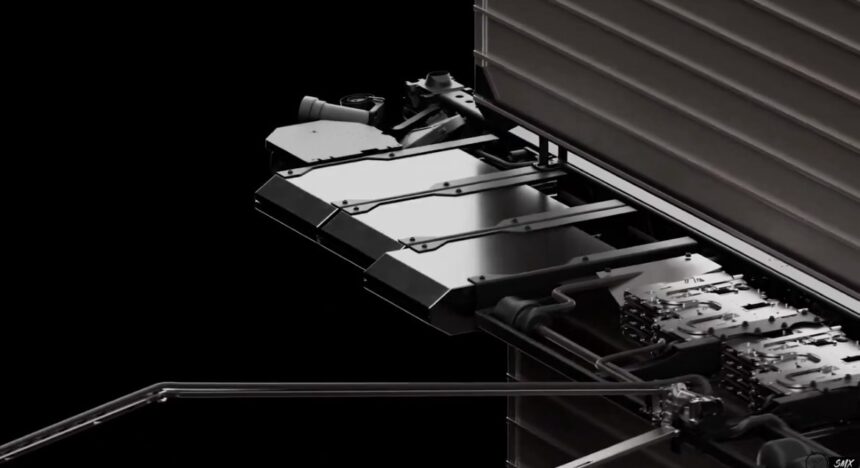
Each planned AI1 satellite could feature a wingspan around 70 meters wide, wider than a Boeing 747. These would generate up to 150 kilowatts of power at peak for onboard computing, roughly the equivalent of multiple server racks. The satellites would use inter-satellite laser links to connect and share workloads.
How Starmind Would Work
Users on the ground would send a request up to the constellation. The nearest or most suitable satellite would process it locally rather than routing everything to a ground facility. This approach could cut latency for many tasks and avoid the round-trip delays and energy losses of traditional setups.
SpaceX has already filed with the FCC for permission to operate up to one million of these satellites. Starship, the company’s heavy-lift rocket, is key to the plan. It could carry dozens of the larger AI satellites per launch, making the numbers feasible over time.
More Read

Two prototype AI1 satellites are scheduled for launch in early 2027. Volume production could ramp up later that year at new manufacturing facilities SpaceX is preparing. Musk has said he believes space will offer the cheapest AI compute within a few years.
Real Challenges Ahead
Not everyone sees this as a sure thing. SoftBank’s Masayoshi Son, who has invested heavily in ground-based AI, has called space data centers pointless. Other skeptics point to several hurdles.
Chip supply remains a big question. Building a million satellites will demand massive numbers of advanced processors. SpaceX talks about new semiconductor fabs, but scaling that production is no small task.
Astronomers have raised concerns about light pollution and interference with telescopes from so many additional objects in the sky. Managing space debris with this many large satellites will also require careful planning to avoid collisions.
Regulatory approval, international coordination, and long-term orbital management add more layers of complexity. Some worry about who controls the processing and outputs when so much compute power sits in orbit outside traditional jurisdictions.
What Success Could Mean
If Starmind works as planned, it could reshape how AI operates. Removing Earth-based constraints on power, cooling, and land could lower costs dramatically and allow much larger scale. This would benefit not only SpaceX and xAI but potentially other companies that pay for access to orbital inference capacity.
More Read

The project builds on Starlink’s success with mass production and rapid deployment of satellites. It also pushes forward the idea of a real economy in low Earth orbit beyond just communications.
For the broader AI industry, it represents a bet that physics favors space for certain types of heavy computing. Ground data centers will not disappear, but hybrid systems or specialized orbital workloads could become common.
Musk has described the satellites as containing interchangeable compute payloads, so different chip designs could be swapped in over time. The first versions focus on inference rather than training new models, which makes sense given the power profiles.
Timeline and Next Steps
We are still early. Prototypes launch next year, with fuller deployment possibly starting in 2028 or later. Much depends on Starship’s reliability at high launch rates and on solving the manufacturing and regulatory pieces.
The name Starmind now has official backing from Musk himself. Whether the full vision reaches a million satellites remains to be seen, but the direction is clear: SpaceX wants to move significant AI capability off the planet.
This development comes at a time when demand for compute keeps climbing. If orbital data centers prove practical, they could ease pressure on terrestrial infrastructure and open new possibilities for AI applications worldwide.
For now, engineers are working on the prototypes, regulators are reviewing the filings, and the public is watching to see what happens when the first AI1 satellites reach orbit. The race to put thought into space is underway.