


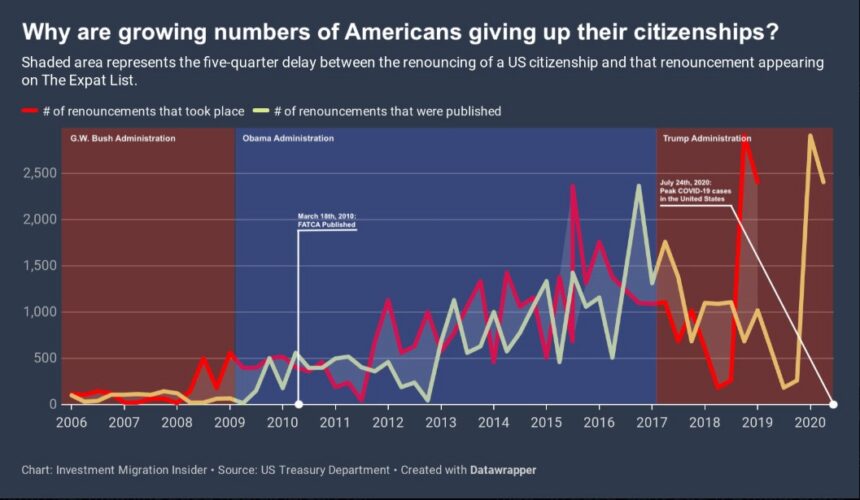
In 2025, nearly 4,900 Americans formally renounced their U.S. citizenship, marking the highest annual total since the record 6,705 in 2020. While still a tiny fraction of the estimated 5–9 million U.S. citizens living abroad, the sustained elevated numbers reflect deep frustrations with U.S. tax policy, banking hurdles, and growing political disillusionment.
The Numbers: A Dramatic Surge Since FATCA
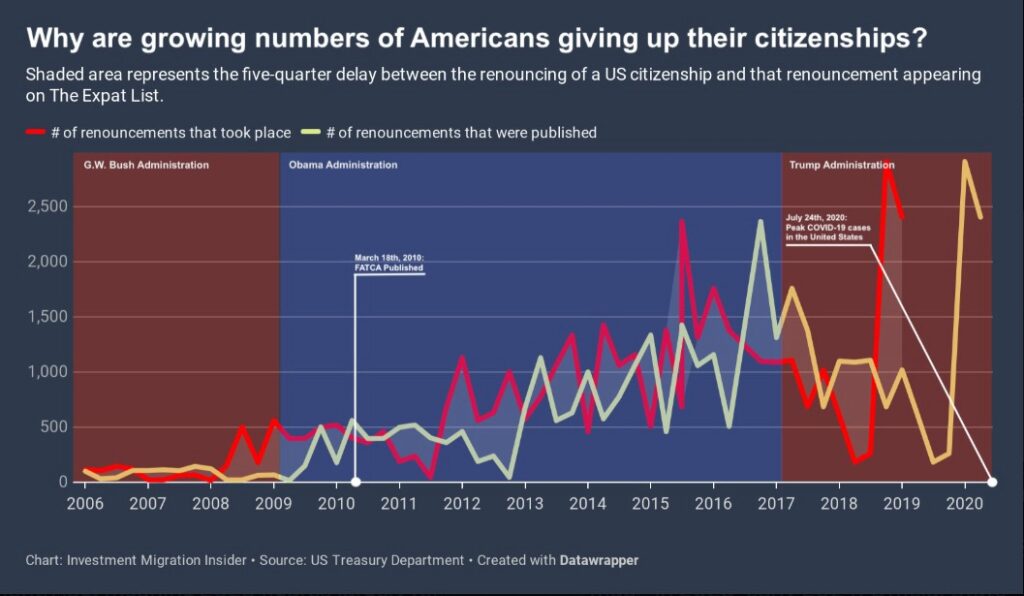
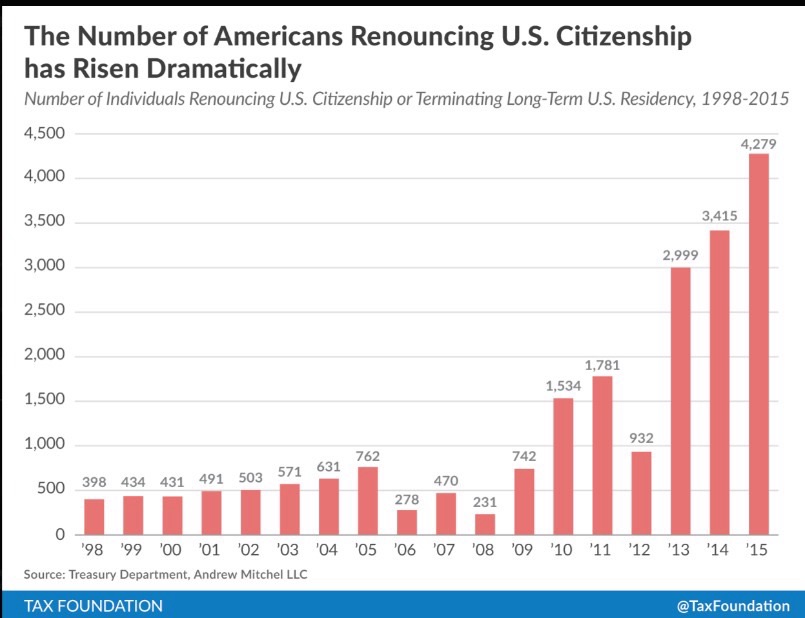
Before 2009, only 200–400 Americans renounced citizenship each year. The numbers began climbing sharply around the time FATCA was enacted in 2010 and fully implemented in 2014.
Key milestones include:
• 2014–2016: Average of roughly 4,800 renunciations annually
More Read

• 2020: All-time high of 6,705 (pandemic disruptions + ongoing compliance burdens)
• 2021: Temporary dip to 2,426
• 2023–2024: Rebounded above 5,000
More Read

• 2025: 4,889 listed in IRS quarterly reports (tallied by groups like Americans Overseas) — the highest since 2020
Primary Driver: The Unique U.S. Tax Burden on Citizens Abroad
The United States is one of only two countries in the world (alongside Eritrea) that taxes citizens on worldwide income based on citizenship rather than residency. This citizenship-based taxation (CBT) creates ongoing obligations even for people who have lived abroad for decades and have no U.S. income.
Key pain points include:
• Annual U.S. tax filing requirements — Even with foreign tax credits and treaties, expats must file complex returns.
• FBAR and FATCA reporting — Foreign Bank Account Reports (FBAR) for accounts over $10,000 and FATCA-mandated disclosures by foreign banks carry severe penalties for non-compliance.
More Read

• Banking discrimination — Many foreign banks refuse or limit services to “U.S. persons” to avoid FATCA’s 30% withholding penalties, complicating everything from opening accounts to getting mortgages or investing.
• Exit tax for “covered expatriates” — High-net-worth individuals or those with compliance issues face a mark-to-market tax on worldwide assets upon renunciation.
“Accidental Americans” — people born in the U.S. or to U.S. parents but raised abroad with minimal ties are particularly affected. Many only discover their obligations when foreign banks flag them under FATCA.
Advocacy groups like Americans Overseas and the Association of Accidental Americans report that tax compliance and banking access are the dominant reasons for most renunciations. A 2025 survey of expats found nearly one in three seriously considering renunciation, largely due to these burdens.
Politics: An Increasingly Important Factor
While taxes remain the top driver, political dissatisfaction has grown in prominence. Lawyers and expat organizations note that polarization around elections, policy directions on immigration, social issues, and governance has pushed more people to reconsider their ties.
In one prominent 2025–2026 example, New Zealand-based dairy farmer Erin Klatt renounced in early 2026 after becoming a New Zealand citizen. She cited both tax burdens and dismay with the direction of the U.S. under President Trump, saying she never felt strongly connected to the country.
Survey data supports the shift: The percentage of U.S. citizens abroad considering renunciation reportedly rose significantly between 2024 and 2025. Political scientists note that shedding U.S. citizenship can serve as a form of emotional regulation for those feeling alienated.
That said, most experts emphasize that politics is usually a secondary or reinforcing factor alongside financial and practical frustrations.
Who Is Renouncing and Why Now?
Renouncers are typically:
• Long-term expatriates and dual citizens
• Middle-income earners (though over one-third of those reporting net worth are millionaires)
• Concentrated in countries like Canada, the UK, Germany, Switzerland, and Hong Kong
Many have built lives, families, and careers abroad and see U.S. citizenship as more liability than asset. For some “accidental Americans,” renunciation restores normal financial life in their home countries.
The Renunciation Process and Recent Fee Cut
Renouncing requires:
1. Obtaining citizenship in another country (if not already held)
2. Filing U.S. tax returns for the prior five years and Form 8854
3. An in-person oath at a U.S. embassy or consulate abroad
4. Receiving a Certificate of Loss of Nationality (CLN)
The process can take months and is generally irreversible.
In a significant policy change, the State Department reduced the administrative fee from $2,350 to $450 effective April 13, 2026 — an 81% cut — following pressure and litigation from accidental American groups.
This lower barrier could contribute to higher numbers in late 2026 and beyond.
Consequences and Considerations
Renouncing means:
• Loss of U.S. passport and right to live/work in the U.S. without a visa
• No automatic transmission of U.S. citizenship to future children in some cases
• Potential need for visas to visit family in the U.S.
• Possible exit tax liability
Experts strongly advise consulting tax attorneys and immigration specialists. Many who renounce report relief from compliance burdens and greater alignment with their adopted country, but the decision is deeply personal and permanent.
Outlook: Elevated Numbers Likely to Continue
With tax rules unchanged, banking challenges persisting for U.S. persons, and political polarization ongoing, experts expect renunciations to remain in the 4,000–6,000+ range annually. The recent fee reduction may provide an additional boost.
Advocacy groups continue pushing for residence-based taxation reform to ease burdens on Americans abroad without encouraging mass renunciations.
For now, the trend underscores a growing disconnect between U.S. policy and the realities of a globalized world — where millions of Americans live, work, and raise families far from home, yet still face unique extraterritorial obligations.
As one renouncer put it: “My life is now outside of the U.S. … I no longer benefit from paying taxes in the U.S.”
The numbers suggest more Americans are reaching similar conclusions every year.