

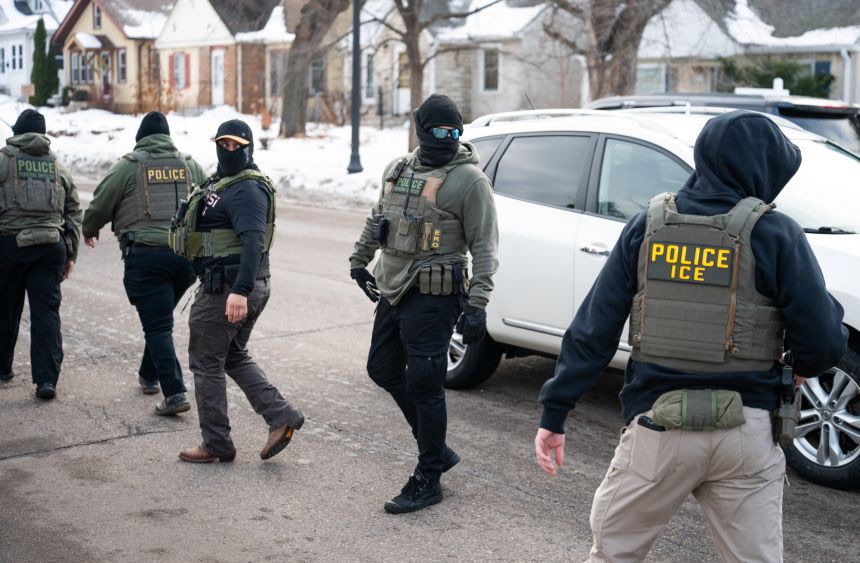
An ICE agent arrested in Texas is now facing criminal charges for shooting a Venezuelan man during a federal immigration enforcement operation in Minneapolis, in a case that exposed alleged lies told by the agent to his own supervisors. Christian Castro, 52, was taken into custody on May 29, 2026, in Harlingen, Texas, by agents with the Department of Homeland Security‘s Office of the Inspector General and the Texas Rangers, more than a week after a Minnesota county issued a nationwide arrest warrant for him.
The case has become one of the most scrutinized incidents to emerge from the Trump administration’s immigration enforcement surge in the Twin Cities.
What Led to the ICE Agent Arrest
The shooting took place on January 14, 2026, during Operation Metro Surge, a three-month federal immigration enforcement campaign that deployed thousands of agents across the Minneapolis and St. Paul metropolitan area. The operation ultimately resulted in nearly 4,000 arrests.
ICE agents were pursuing Alfredo Aljorna, a Venezuelan man, following a car chase. Aljorna crashed his vehicle into a snowbank and ran toward his home. Julio Sosa-Celis, Aljorna’s roommate, was standing outside the home at the time, holding a snow shovel.
According to prosecutors, after a brief physical confrontation between Sosa-Celis, Aljorna, and a federal agent, both men retreated back toward the house. Castro then fired his weapon through the front door of the home, striking Sosa-Celis in the leg.
More Read
Castro initially told his ICE supervisors that he had been attacked with a shovel and brooms and only opened fire in self-defense after being beaten to the ground. Minneapolis police footage later revealed what officials described as a materially different set of circumstances, directly contradicting Castro’s account.
What the Video Evidence Revealed
The video footage undermined Castro’s self-defense claim and triggered a chain of events that unraveled the government’s initial version of events.
Federal prosecutors had originally charged both Sosa-Celis and Aljorna with assault on a law enforcement officer, based on Castro’s account. Those charges were later dropped after ICE formally acknowledged that the federal agents involved had made “false statements” under oath. The government’s own admission effectively reversed the narrative it had used to justify the shooting.
More Read
ICE placed Castro on administrative leave in February 2026. A nationwide arrest warrant for him was issued by the Hennepin County Attorney’s Office before his arrest in Texas.
The Charges the ICE Agent Is Facing
Castro has been charged with four counts of second-degree assault with a deadly weapon and one count of falsely reporting a crime. He was booked into Cameron County Jail in Texas on a Minnesota arrest warrant.
Hennepin County Attorney Mary Moriarty said in a statement: “Today’s arrest is a critical step forward in our prosecution of Mr. Castro. The BCA’s investigative work was instrumental in this process and we’re grateful for their collaboration as we pursue accountability for this incident on behalf of Mr. Sosa-Celis, his family, and our community.”
Minnesota Attorney General Keith Ellison said he was pleased by the ICE agent arrest. “In Minnesota, we believe in equal justice under the law. That means nobody is above the law, including agents of the federal government,” Ellison said. “Christian Castro’s alleged shooting of Julio Sosa-Celis appears unwarranted, as evidenced by the lies Castro told his ICE supervisors to justify his unlawful actions.”
How DHS Responded to the ICE Agent Arrest
The Department of Homeland Security pushed back sharply against the state-level prosecution. A DHS spokesperson called Castro’s arrest “unlawful” and dismissed it as a “political stunt,” arguing that the agent’s conduct should be handled at the federal level, not by state prosecutors.
Minneapolis Mayor Jacob Frey offered a starkly different view. “Our city was invaded, and people were shot,” Frey said in response to questions about the arrest.
More Read
The Justice Department had originally charged Sosa-Celis with assault, a move that was later reversed after new evidence emerged. ICE’s reversal and the agent’s own alleged false report now form the core of the state’s criminal case.
Two American Citizens Were Also Killed During Operation Metro Surge
The shooting of Sosa-Celis was not the only use of deadly force during the operation. Two American citizens were killed by federal agents during Operation Metro Surge.
Renee Good, a 33-year-old mother of three, was fatally shot by an ICE agent on January 7, 2026. Alex Pretti was also killed during the enforcement surge. Both deaths sparked weeks of public protests across Minneapolis and prompted civil lawsuits from both the city and the state governments against the federal operation.
The Minneapolis case also mirrors a similar incident in Chicago, where Marimar Martinez, an American woman, was shot by a federal agent in her vehicle. The government claimed Martinez had rammed the agent’s vehicle and that the shots fired were defensive. That account was later contradicted by video evidence and text messages showing the officer boasting about the shooting, leading a judge to dismiss the federal charges against Martinez.
What Comes Next in the Castro Case
Castro is expected to be extradited from Texas to Minnesota to face the charges filed against him in Hennepin County. The Minnesota Bureau of Criminal Apprehension confirmed his arrest was “the next step in a long-established legal process.”
The outcome of this case is being watched closely by immigration advocates, civil rights attorneys, and federal accountability groups who argue it will test whether federal agents can be held criminally liable under state law for actions taken during immigration enforcement operations.
If you or someone you know has been affected by immigration enforcement actions, a licensed immigration or civil rights attorney can advise on your legal options.