

Republican-led measure denounces socialism and the Democratic Socialists of America while backing election integrity measures ahead of midterms.
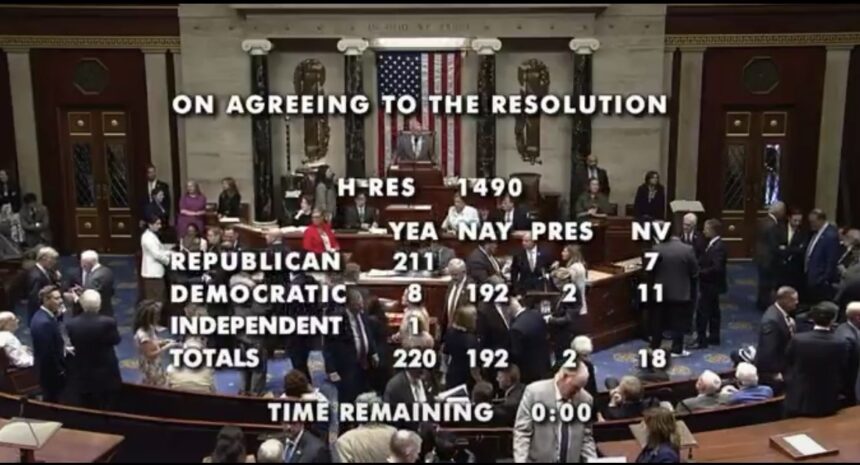
WASHINGTON — The U.S. House of Representatives on Tuesday, September 1, 2026, adopted a non-binding resolution formally condemning and denouncing socialism “in all its forms,” including the Democratic Socialists of America (DSA), by a vote of 220-192.
The resolution, H.Res.1490, was introduced by Rep. Jeff Crank (R-CO-05). It passed with support from all voting Republicans and eight Democrats. Two Democrats voted present.
Key Provisions of the Resolution
The measure states that the House:
- Condemns and denounces socialism in all its forms, including the Democratic Socialists of America, and opposes the implementation of socialist policies in the United States.
- Reaffirms support for free, fair, and secure elections and calls for enactment of the SAVE America Act.
- Reiterates that American elections should be decided by American citizens only.
- Recommits to upholding the U.S. Constitution.8
In floor remarks and press statements, supporters highlighted concerns over DSA-affiliated candidates’ recent primary successes and platform positions that include expanded voting rights for noncitizens in some contexts, among other policies.
More Read

Rep. Crank said the vote demonstrated a clear divide: “The vast majority of Democrats voted against my resolution to condemn socialism in all its forms. 10-15 years ago, a resolution like this would’ve passed the House unanimously. The DSA is a threat to the American values that make our nation great.”
House Majority Leader Steve Scalise linked the resolution to election security, stating that denouncing socialism also means rejecting “the idea of people that aren’t American citizens voting in our elections, because that’s part of their platform.”
Bipartisan Crossover and Democratic Opposition
The eight Democrats who voted in favor were Reps. Kathy Castor (Florida), Henry Cuellar (Texas), Don Davis (North Carolina), Jared Golden (Maine), Vicente Gonzalez (Texas), Marie Gluesenkamp Perez (Washington), Darren Soto (Florida), and Gabe Vasquez (New Mexico).
Nearly the entire Democratic caucus opposed the measure. Critics described it as a political messaging exercise timed ahead of the November elections, designed to force Democrats into an uncomfortable position amid gains by progressive and DSA-endorsed candidates in primaries.
Some moderate Democrats who might otherwise have supported a pure condemnation of socialism objected to the inclusion of language supporting the SAVE America Act, a voter identification and election integrity bill backed by Republicans that remains stalled in the Senate.
Political Context
Republicans scheduled the vote following a series of primary victories by candidates associated with the Democratic Socialists of America. Supporters of the resolution argue that socialism has historically led to concentrated power, economic failure, and authoritarian outcomes, citing historical examples of mass suffering under socialist and communist regimes.
The resolution is non-binding and carries no force of law. It functions primarily as a statement of position and a political signal in the current congressional session.
Prediction market platform Polymarket highlighted the vote, noting the concurrent positioning of democratic socialist figures in Democratic Party nomination markets looking ahead to 2028.
What’s Next
The House action puts formal congressional language on the record condemning socialism and the DSA. Whether the resolution influences Senate dynamics on related election measures or shapes campaign messaging in the coming months remains to be seen. Democrats who opposed it largely framed the vote as partisan theater rather than substantive policy.
More Read

The full text of H.Res.1490 is available through Congress.gov.