


As a U.S. Naval Blockade Tightens and Ceasefire Talks Stall, Iranian Hardliners Are Reaching for Unconventional Leverage
A Crisis With No Off-Ramp in Sight
The Strait of Hormuz has been one of the world’s most contested waterways for decades. Since February 2026, it has become something else entirely: the central pressure point of an active military confrontation between Iran and the United States, a standoff that has already disrupted global energy markets, damaged undersea digital infrastructure, and now reportedly prompted Tehran to consider weapons that belong, in most people’s minds, to the realm of Cold War fiction.
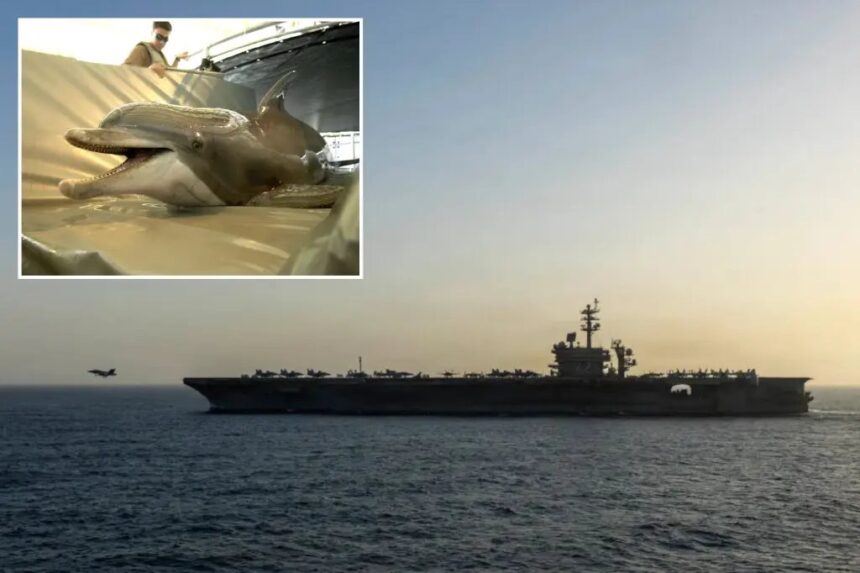
One of those weapons is a dolphin. Armed with a mine.
The Broader Context: How the Strait Got Here
The Strait of Hormuz has been largely blocked since February 28, 2026, when the United States and Israel launched airstrikes on Iran, targeting military and government sites and resulting in the death of Supreme Leader Ali Khamenei. In retaliation, Iran launched missile and drone attacks on U.S. military bases and allied Gulf states, and the IRGC issued warnings forbidding passage through the strait, boarding and attacking merchant vessels and laying sea mines in the waterway.
Before the conflict, the Strait of Hormuz was the passage point for roughly 25% of the world’s seaborne oil trade and 20% of global liquefied natural gas shipments. On April 13, 2026, the U.S. imposed a naval blockade on Iranian ports, creating what observers have described as a dual blockade, with Iran restricting westbound commercial traffic while Washington intercepted ships moving to and from Iranian territory.
A ceasefire was announced and extended, but the blockade remained in place. Islamabad talks between U.S. and Iranian officials in April collapsed after twenty-one hours with no agreement reached.
It is within that stalled and economically damaging standoff that reports of unconventional Iranian military planning have emerged.
Mine-Carrying Dolphins: Not Science Fiction, Just Very Old Science
With the ceasefire technically holding but Iranian hardliners increasingly viewing the U.S. blockade on oil exports as an act of war, Iranian officials have reportedly discussed resuming military action using previously unused weapons systems, including mine-carrying dolphins, according to the Wall Street Journal.
The concept is less far-fetched than it sounds. Military use of marine mammals, particularly dolphins, has a documented history. The U.S. Navy has maintained a Marine Mammal Program since the 1960s, deploying dolphins trained to detect underwater mines and enemy divers. The Soviet Union ran a similar program, and after the USSR dissolved, those trained animals were reportedly transferred to Ukraine.
What Iran is reportedly considering is a more offensive application of the same concept: training dolphins to carry mines toward enemy vessels rather than simply locating explosives. It is worth noting that the U.S. military has itself deployed trained dolphins in the Hormuz region during this conflict, not as weapons but as mine-clearance assets, using their natural sonar capabilities to detect the very mines Iran has already laid in the strait.
The irony of that parallel is not subtle.
Submarines Into the Strait
The dolphin report is not the only unconventional option on Iran’s table. Iranian officials also discussed deploying submarines into the waterway , a move that would significantly complicate U.S. naval operations in a body of water that narrows to roughly 33 kilometres at its tightest point.
Iran’s conventional navy was largely destroyed during the initial phase of the conflict. However, roughly 60% of the IRGC’s naval arm, which was specifically built for asymmetric warfare and includes fast-attack speedboats, remains operational. Submarine activity in that confined geography would pose detection and interdiction challenges that surface naval operations do not.
The Internet Cable Threat: A Digital Catastrophe on Standby
Of the three escalation options in circulation, the cable threat may have the most immediate global consequence.
On April 22, Iran’s IRGC-affiliated Tasnim news agency published what analysts described as a thinly veiled threat regarding the undersea internet cables running through the Strait of Hormuz. The report emphasized that the strait serves as a critical passage for most of the communications cables linking the region to the rest of the world, describing it as a strategic weak point.
Tasnim noted that at least seven major communications cables pass through the route, with cables such as TGN-Gulf, AAE-1, Falcon, and SEA-ME-WE linking significant portions of regional digital communications to data centers in the Middle East, Europe, and Asia.
Gulf states and U.S. allies in the region rely on those cables for over 90% of their internet, banking, and cloud services. Iran, by contrast, relies on them for less than 40% of its internet capabilities, giving Tehran significant asymmetric leverage in any decision to sever them.
The practical consequences of a cable-cutting operation would extend well beyond the region. The conflict has already created a second major chokepoint alongside the Red Sea, and the simultaneous closure of both represents an unprecedented stress test for global internet infrastructure. Cable repair ships have been forced to suspend operations in what experts describe as an effective no-go zone, meaning any severed cables could remain offline for the entire duration of the conflict.
Iranian drones have already struck data centers in Bahrain and the UAE during the conflict, with warnings issued against what IRGC-linked media called “enemy technology infrastructure.” The Tasnim report appeared to extend that framing to the undersea cables themselves.
What Happens If Any of These Options Are Exercised
Each of the three measures carries a different risk profile and a different set of consequences for the broader conflict.
Armed dolphins represent an asymmetric, largely deniable capability with limited strategic reach. Their real function, if deployed, may be less about sinking warships and more about demonstrating that Iran retains creative options its adversaries have not fully prepared for.
Submarine deployment in the strait would represent a direct military escalation in one of the most heavily monitored waterways on earth, and would almost certainly trigger a kinetic U.S. response.
Cable sabotage is the option with the most disproportionate global impact relative to the military risk to Iran. The IRGC has already threatened to sever the seven submarine internet cables passing through Hormuz, a move that analysts say would trigger what some have described as a digital catastrophe for Gulf states that are far more dependent on those cables than Iran itself.
On April 23, Trump ordered the U.S. Navy to destroy any Iranian boats found laying mines in the strait , a signal that Washington’s tolerance for further escalation has limits it is prepared to enforce militarily.
The standoff continues, with no diplomatic resolution in sight, a blockade showing no signs of lifting, and a growing menu of unconventional Iranian options that each carry their own set of unpredictable consequences.