


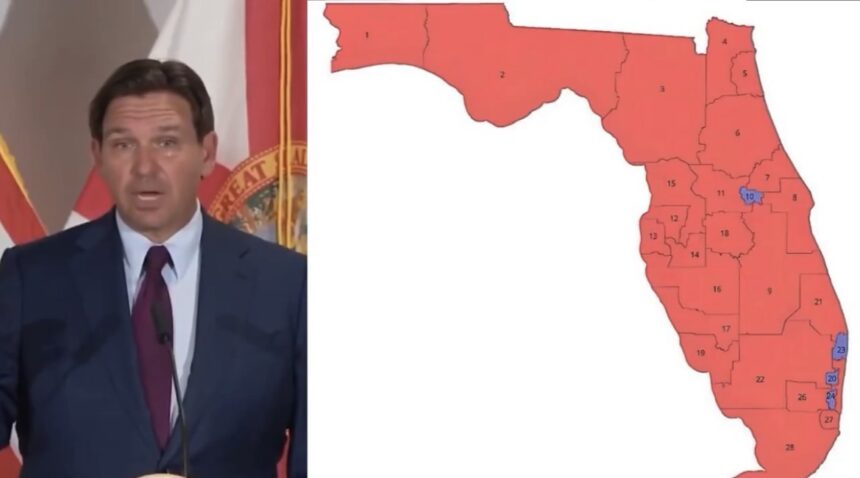
TALLAHASSEE — Florida Governor Ron DeSantis has officially signed the state’s new congressional district maps into law, finalizing a redistricting effort that is projected to hand Republicans up to four additional seats in the U.S. House of Representatives ahead of the 2026 midterms.
The move comes after the Florida legislature passed the revised maps earlier this month. DeSantis, who has made redistricting reform a priority during his governorship, described the new boundaries as fairer and more reflective of the state’s current population and political realities.
Republican strategists believe the updated maps could shift the balance of power in Florida’s delegation from its current 20-8 Republican advantage to as many as 24-4. The changes primarily affect districts in South Florida and Central Florida, where population growth and demographic shifts have occurred in recent years.
The signing was celebrated by many conservatives, who view it as a model for other Republican-led states. Several online commentators urged Southern and red states to follow Florida’s example before the 2026 elections.
Background on Florida’s Redistricting
Florida’s congressional maps have been a point of contention for years. After the 2020 census, the state gained an additional congressional seat due to population growth. Previous maps were challenged in court by Democrats, who argued they diluted minority voting power.
More Read

The new maps were drawn using what supporters call “race-neutral” standards, in line with recent Supreme Court guidance that has limited the use of race as the predominant factor in drawing districts. Governor DeSantis and Republican lawmakers argue the updated boundaries respect traditional districting principles such as compactness, contiguity, and respect for political subdivisions.
Democrats have criticized the maps as aggressive gerrymandering designed to maximize Republican advantage. Some legal challenges are expected, though the state’s Republican-controlled courts and the recent Supreme Court ruling on racial gerrymandering may make successful lawsuits more difficult.
What the Maps Change
The revised districts are expected to make several competitive or Democratic-leaning seats more Republican-friendly. Key shifts include:
More Read

- Strengthening Republican performance in South Florida districts with large Hispanic populations.
- Adjusting boundaries in the Orlando and Tampa areas to reflect growing conservative suburbs.
- Creating more solidly Republican districts in parts of Central and Southwest Florida.
Analysts estimate the net gain for Republicans could be three to four seats, depending on candidate quality and national political trends in 2026.
DeSantis’ Strategy and National Implications
Governor DeSantis has positioned himself as one of the most aggressive Republican leaders on redistricting. By moving quickly to lock in favorable maps, Florida is setting an example for other GOP-controlled states such as Texas, Georgia, and South Carolina, which are also expected to redraw or defend their maps before the midterms.
Supporters argue this is simply smart politics using legal tools available after the census to reflect the will of the voters. Critics call it an attempt to entrench Republican power regardless of demographic changes or voter preferences.
The timing is significant. With control of the House of Representatives potentially hanging in the balance in 2026, every seat counts. Florida’s changes alone could make it significantly harder for Democrats to retake the majority.
Reactions Pour In
The announcement triggered strong reactions across the political spectrum. Many conservatives praised DeSantis for being proactive and “playing to win.” Some called for other red states to act quickly and adopt similar maps.
On the other side, Democrats and voting rights groups accused Florida Republicans of undermining fair representation. A few voices warned that aggressive map-drawing could backfire if national political winds shift strongly against Republicans.
Legal experts note that while lawsuits are likely, the combination of state-level control and favorable recent Supreme Court precedent gives Republicans a strong defensive position.
What Comes Next
The new maps are now official law in Florida. Candidates for the 2026 midterms will begin campaigning under the revised boundaries, which could reshape primary races and general election strategies across the state.
For Governor DeSantis, the signing reinforces his image as a decisive conservative leader willing to push boundaries to advance Republican priorities. For the national GOP, Florida’s move serves as both a blueprint and a morale boost heading into a critical election cycle.
Whether other states follow Florida’s lead and how courts ultimately rule on any challenges, will be one of the most important redistricting stories of 2026.