

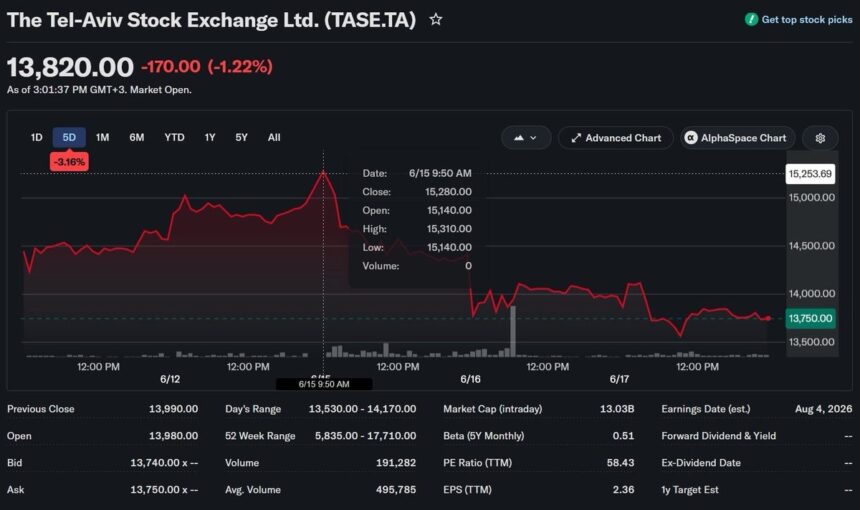
The Tel Aviv Stock Exchange has been in freefall this week, with all major indices posting sharp losses in the three trading sessions since a new U.S.-Iran nuclear agreement was announced. In that window alone, the exchange shed more than 2 billion shekels in market capitalization, and there are no signs yet that the selling pressure is about to let up.
The losses are not random. They reflect something specific: Israeli investors, institutional and retail alike, are treating this deal as a direct threat to national security, and they are adjusting their portfolios accordingly.
The broader message from the market is about as direct as it gets. When three indices fall together, corporate bonds slip, and billions of shekels evaporate inside 72 hours, the market is not confused. It has made a judgment.
Tel Aviv Stock Exchange Indices: What the Numbers Show
The damage this week has been broad and consistent across every segment of the Israeli market.
The Tel Aviv 35 Index, which tracks the country’s 35 largest publicly traded companies, fell 2.01% to close at 4,255.89. The Tel Aviv 125 Index, a wider gauge that captures mid-cap companies alongside the heavyweights, dropped 2.34% to 4,191.81. The BlueTech Global Index, which follows Israeli technology companies with global market exposure, declined 1.60% to 689.98.
More Read
Even the bond market joined the selloff. The TelBond 60, which tracks Israeli corporate bonds, also slipped during the period. That detail matters. Equity investors are often quick to react emotionally to geopolitical news, but bond investors tend to be more deliberate. When both asset classes move in the same direction at the same time, it typically signals a structural concern rather than a short-term panic.
The combined losses over the three-day stretch erased more than 2 billion shekels in market cap from the exchange. That is significant enough on its own, but the longer-term picture makes the current moment look even more serious. The Tel Aviv Stock Exchange peaked at 17.2 billion shekels in May. It is now sitting below 13.9 billion. That is a decline of more than 3.3 billion shekels from the recent high, with roughly 2 billion of that loss concentrated in just the past three days. The pace of the decline has clearly accelerated since the deal was announced, and that timing is not coincidental.
Why the U.S.-Iran Deal Is Rattling the Tel Aviv Stock Exchange
To understand why Israeli markets are moving this way, you have to understand what this agreement means in concrete security terms.
More Read

Iran has been Israel’s primary state-level adversary for decades. It funds and arms Hezbollah in Lebanon, has supported militant operations in Gaza, and maintains a network of regional proxies that have been directly involved in conflicts affecting Israeli civilians and military personnel. For Israeli policymakers and the public, any deal that eases international pressure on Tehran, whether through sanctions relief or tacit acceptance of parts of its nuclear program, is not just a diplomatic development. It is a change in the threat environment.
Markets price in perceived security conditions. When investors see a shift that they believe increases the risk of conflict or reduces American backing for Israeli deterrence, they reprice assets. That is exactly what appears to be happening right now.
The decline in the BlueTech Global Index is worth noting specifically. Israeli technology companies have long attracted significant foreign institutional investment. International fund managers holding positions in Israeli tech tend to reduce exposure quickly when geopolitical risk spikes, because their mandates often require them to manage country-level risk actively. A sustained selloff in BlueTech would indicate that foreign capital is beginning to exit, not just that domestic investors are nervous.
What Comes Next for Israeli Markets
The central question now is whether this is a correction that bottoms out and reverses, or the beginning of a more sustained downturn.
Historically, the Tel Aviv Stock Exchange has recovered relatively quickly from geopolitical selloffs when clarity returned to the situation. Markets do not like uncertainty, but they can absorb bad news once it is fully priced in. The problem at this moment is that nothing about this situation is fully priced in yet. The details of the agreement are still being processed. The Israeli government’s official response is still taking shape. And the U.S. administration has not yet made a visible effort to reassure Israel publicly in a way that might calm investor sentiment.
If the situation escalates, whether through direct military action or a sharp rupture in the U.S.-Israel relationship, the losses already seen this week would likely deepen. If diplomatic channels open and reassurances follow, a partial recovery is possible. But for now, the market is working with incomplete information and pricing in risk accordingly.
More Read

The drop from a May peak of 17.2 billion shekels to below 13.9 billion is a number Israeli financial and political leaders will not be able to ignore. Markets in democracies carry political weight, and a sustained erosion of this magnitude sends a signal that goes well beyond trading floors.
For now, the Tel Aviv Stock Exchange has made its position on the U.S.-Iran agreement clear. Whether policymakers in Washington or Tel Aviv respond to that signal is a separate question entirely.