

For decades, the war on cancer has been defined by a frustrating pattern. Surgery removes the tumour. Chemotherapy and radiation mop up what remains. Patients enter remission, sometimes for years. And then the cancer comes back, often more aggressive than before, often in a different organ, and often resistant to the treatments that worked the first time. That pattern of relapse has been one of oncology’s most stubborn and deadly problems. A team of researchers from Singapore and China believe they have found a new and fundamentally different way to break it.
Scientists at the Yong Loo Lin School of Medicine at the National University of Singapore, working jointly with researchers from the National Center for Nanoscience and Technology at the Chinese Academy of Sciences, have developed a novel nanovaccine called NICER that targets both the main mass of a tumour and the elusive population of cells responsible for cancer returning after treatment. The research was published in the prestigious journal Nature Nanotechnology in 2025 and has generated significant attention in the global oncology and biotechnology communities since.
The Problem NICER Was Built to Solve
To understand why this research matters, it helps to understand the enemy it is designed to fight. Most cancer treatments, whether surgery, radiation, or chemotherapy, are reasonably effective at reducing the primary tumour burden. The cells that form the visible, measurable mass of a cancer can often be destroyed or removed. What remains, and what conventional therapies have historically struggled to eliminate, is a small, resilient subpopulation of cells known as cancer stem cells, or CSCs.
CSCs are sometimes described as the seeds of cancer. They can lie dormant within tumour tissue during treatment, effectively hiding from chemotherapy and radiation by remaining in a non-dividing state that these therapies cannot efficiently target. Once treatment ends and conditions become more favourable, CSCs can reawaken, triggering a new cycle of tumour growth. This process drives post-surgical relapse, the return of cancer at the original site, and metastasis, the spread of cancer to distant organs like the lungs, liver, or brain.
More Read

There are currently no efficient clinical strategies for reliably tracking and eradicating CSCs. That is the gap NICER was designed to fill.
How NICER Works
The full name of the vaccine is NICER: Nanovesicle Integrating CSC-specific antigen display and epigenetic nano-regulator encapsulation. That name, dense as it is, describes precisely what the technology does.
More Read

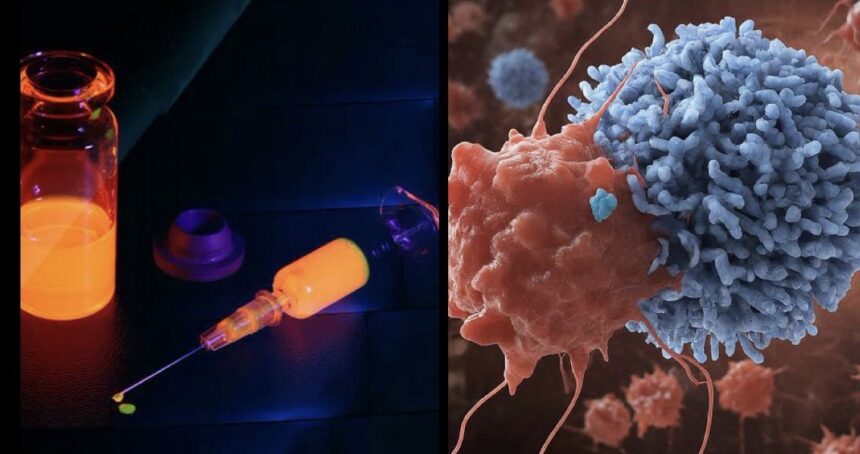
At its core, NICER is built from nanovesicles, tiny biological particles derived from tumour cells that have been engineered to overexpress a protein called aldehyde dehydrogenase, a marker highly expressed on cancer stem cells. These nanovesicles carry two types of antigenic material simultaneously: CSC-specific antigens that teach the immune system to recognise and attack cancer stem cells, and conventional tumour-associated antigens that prime the immune system against the broader cancer cell population. It delivers what researchers describe as a dual blow.
The system also incorporates a dendritic-cell-targeting aptamer, a molecular homing device that directs the nanovaccine toward dendritic cells, which are the immune system’s primary antigen-presenting cells. When dendritic cells receive and process the NICER payload, they mount a coordinated immune response against both target populations, activating T cells and, critically, establishing lasting immune memory. The vaccine essentially trains the body’s own immune system to recognise and attack cancer cells that surgery and conventional treatment leave behind, and to remember that target long after the initial treatment is complete.
An additional mechanism within the nanovaccine inhibits a specific enzyme pathway in dendritic cells that would otherwise degrade the antigens before the immune response can be fully mounted. This epigenetic regulation step is what allows NICER to generate a stronger and more durable immune activation than prior approaches.
What the Preclinical Data Shows
The results from animal models are, by any reasonable scientific measure, impressive. In laboratory models of breast cancer, melanoma, and highly aggressive CSC-enriched tumours, NICER halted tumour growth and reduced both cancer recurrence and lung metastasis following surgical removal of the primary tumour. When combined with immune checkpoint inhibitors, the class of immunotherapy drugs that have already transformed treatment for certain cancers, the nanovaccine demonstrated what researchers described as synergistic effects, with enhanced tumour control and improved survival outcomes in the test models.
The reduction in recurrence and metastasis was measured at up to seven times more effective than existing approaches in some models, according to reporting from the South China Morning Post.
More Read

“In laboratory models which included breast cancer, melanoma, and highly invasive CSC-enriched tumours, NICER not only halted tumour growth but also reduced recurrence and lung metastasis following surgical tumour removal,” said Dr Qing You, the paper’s first author from the Department of Diagnostic Radiology at NUS Medicine.
Professor Shawn Chen Xiaoyuan, Director of the Nanomedicine Translational Research Programme at NUS Medicine and the paper’s senior corresponding author, described the significance of the approach in terms of what it means for one of oncology’s longest-standing obstacles. “Our results show that our nanovaccine not only activates the immune system to attack these cells, but also creates lasting memory to help prevent the cancer from returning,” he said.
What This Is, and What It Is Not Yet
Accuracy matters enormously when reporting on cancer research, and this research warrants both excitement and careful framing. NICER is a genuinely important scientific development. It addresses a real and previously unsolved problem in oncology, its mechanism is scientifically sound, and it has been published in one of the most rigorous peer-reviewed journals in nanomedicine. The preclinical results are among the most promising seen in this field.
It is not, however, a cure for all cancers, nor has it been tested in human patients. The research is currently at the preclinical stage, meaning its results come from animal models rather than clinical trials. The path from a promising animal study to an approved human therapy is long, typically spanning many years of Phase I, II, and III clinical trials designed to establish safety, determine dosing, and confirm efficacy in human populations. Many therapies that perform well in animal models do not ultimately translate to humans with the same effectiveness.
The researchers themselves have been careful to frame NICER as a significant step toward personalized cancer vaccines and post-operative immunotherapy rather than a universally applicable cure. They have noted that next-generation enhancements could further boost efficacy through precision immune cell targeting and improved antigen design, signalling that the current version of the technology is a foundation rather than a final product.
The vaccine is also designed specifically for post-surgical use, deployed after tumour removal to prevent recurrence and metastasis, rather than as a preventive vaccine administered to healthy individuals. Its broad-spectrum potential refers to its ability to address multiple cancer types through its targeting of CSCs, which are present across a wide range of tumour types, not to a single-shot prevention of all cancers in the way that, for example, the HPV vaccine prevents cervical cancer.
Why It Still Represents a Paradigm Shift
None of those caveats diminish the importance of what this team has achieved. The concept of a broad-spectrum post-surgical cancer vaccine that simultaneously addresses tumour bulk and cancer stem cells is genuinely novel. Previous approaches to cancer immunotherapy have generally focused on one or the other. Checkpoint inhibitors, for example, remove the brakes from the immune system but do not specifically direct it toward CSCs. Personalised neoantigen vaccines target tumour-specific mutations but are expensive, time-consuming to manufacture, and not easily scalable.
NICER’s design is potentially both broad-spectrum and relatively manufacturable. Because it derives its antigens from the patient’s own tumour cells, it carries the personalisation advantage. Because CSCs share certain molecular markers across cancer types, particularly the aldehyde dehydrogenase overexpression that the nanovesicle platform targets, the approach has potential applicability across multiple tumour types without requiring a completely bespoke manufacturing process for each patient.
The combination with immune checkpoint inhibitors is also a meaningful signal. The synergistic effects observed in preclinical models suggest that NICER could eventually slot into existing immunotherapy treatment frameworks as an add-on or combination therapy rather than requiring a complete departure from established oncology protocols.
The Road Ahead
The research team has indicated that the next phase of development will focus on refining the antigen design and exploring precision immune cell targeting to enhance efficacy. The path to clinical trials will require additional preclinical safety data, manufacturing scale-up studies, and regulatory submissions to health authorities in Singapore, China, and eventually the US and EU if the therapy is to reach global patients.
Global cancer statistics make the urgency of this work plain. Cancer remains the second leading cause of death worldwide, claiming nearly ten million lives annually. Post-surgical recurrence and metastasis account for the majority of those deaths. A therapy that can meaningfully reduce the rate at which cancers return after surgery, even in a subset of patients, would represent one of the most significant advances in oncology in a generation.
NICER may be that therapy. Or it may be the scientific foundation on which that therapy is ultimately built. Either way, the work coming out of the National University of Singapore and the Chinese Academy of Sciences has given the global cancer research community something it has rarely had in the past: a genuinely new and mechanistically sound approach to the oldest and hardest problem in the field.
Sources: Nature Nanotechnology, EurekAlert, Newsweek, South China Morning Post, Phys.org, BioSpectrum Asia
This article is provided for informational purposes only and does not constitute medical advice. Patients with cancer or concerns about their health should consult a qualified medical professional.