

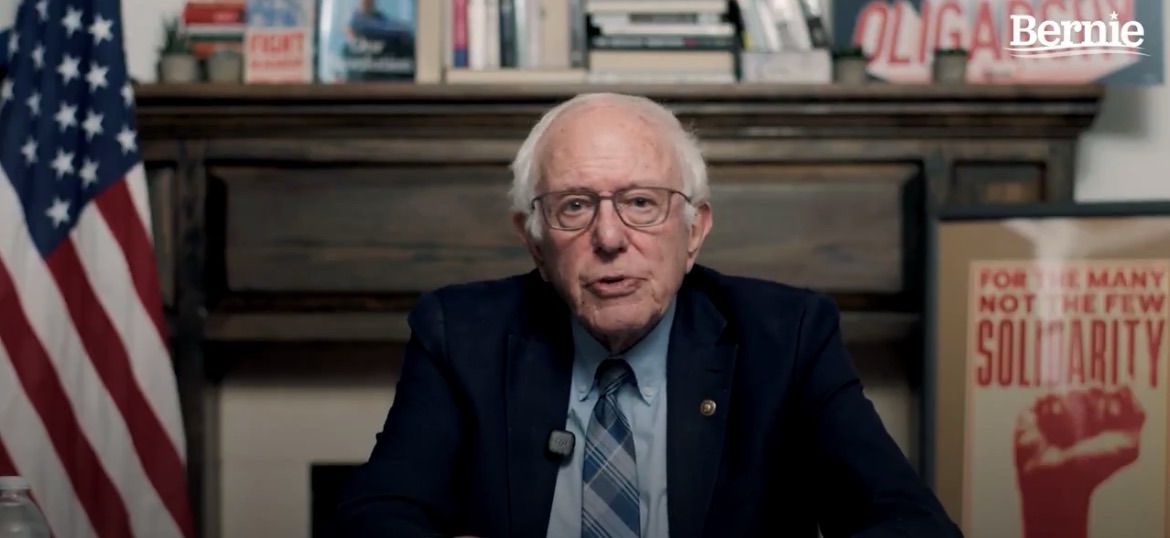
WASHINGTON — Senator Bernie Sanders is drawing sharp criticism after announcing a Capitol Hill panel tonight featuring two Chinese AI researchers, just as the Trump administration warns that the United States is falling behind in the race to dominate artificial intelligence.
The event, focused on “international AI ethics and safety guidelines,” includes professors from MIT, the University of Montreal, and two Chinese universities. Republicans have been quick to condemn the panel, arguing it gives Beijing access to sensitive discussions at a time when China is aggressively advancing its own AI capabilities and restricting American companies.
Conservative commentator Gunther Eagleman highlighted the controversy, calling it “BOOM!” and accusing Sanders of cozying up to Chinese interests while Beijing races to surpass America in this critical technology. The backlash intensified after Congressman Andy Harrigan publicly criticized the senator.
“China is aggressively locking down the most powerful AI assets and shutting American companies out,” Harrigan said. “Bernie Sanders wants to hand them a seat at the table. Make that make sense.”
Sanders’ Defense and the Panel’s Stated Goal
Sanders has defended the event by arguing that artificial intelligence poses existential risks that transcend national borders. He claims the United States must engage with both allies and adversaries to address issues such as mass job displacement and the potential loss of human control over powerful AI systems.
Supporters of the panel say open dialogue on safety standards and ethical guidelines is necessary to prevent a dangerous, unregulated arms race. They point out that AI development is happening globally and that isolation could leave the U.S. without influence over international norms.
Critics, however, see the timing and participants as deeply problematic. They argue that inviting Chinese researchers especially from institutions closely tied to the Chinese government and military risks sharing strategic insights at a moment when Beijing is pouring resources into military-civil fusion AI programs.
The Broader U.S.-China AI Competition
The controversy comes against a backdrop of growing alarm in Washington about China’s rapid AI progress. U.S. intelligence and defense officials have repeatedly warned that China aims to become the world leader in AI by 2030. Beijing has made massive investments in computing power, talent recruitment, and data collection while imposing strict controls on how American tech firms operate inside China.
Recent actions by the Trump administration include tighter export controls on advanced chips and increased scrutiny of Chinese investments in U.S. AI startups. Officials worry that China could use AI advantages in areas such as autonomous weapons, surveillance, cyber operations, and economic espionage.
Republicans and some Democrats argue that engagement with Chinese researchers should be approached with extreme caution. They point to past cases where academic exchanges allegedly served as cover for technology transfer benefiting the Chinese military.
Reactions and Political Fallout
The response has fallen largely along partisan lines. Many conservatives view Sanders’ panel as consistent with his long-held socialist views and perceived softness toward adversarial regimes. Some have gone further, labeling the event as naive at best and potentially harmful to national security at worst.
On the other side, progressive voices and some technology ethicists defend the need for global cooperation on AI safety. They argue that refusing to talk with Chinese experts would only accelerate an unchecked arms race and increase the chances of dangerous miscalculations.
Sanders himself has a long record of advocating for international cooperation on major issues, from climate change to arms control. His supporters say this panel fits that pattern. His critics counter that AI is fundamentally different because of its dual-use military potential and the authoritarian nature of the Chinese regime.
What This Reveals About the AI Debate
The uproar over Bernie Sanders’ panel highlights a deeper tension in American politics: how to balance the need for international collaboration on emerging technologies with legitimate national security concerns.
Artificial intelligence is developing at breakneck speed. Its applications range from life-saving medical tools and productivity gains to powerful autonomous weapons and sophisticated surveillance systems. Deciding where to draw the line between open scientific exchange and protecting strategic advantages has become one of the most difficult policy challenges of the decade.
The event also underscores how polarized Washington has become. Even discussions framed around “ethics and safety” are now viewed through a geopolitical and partisan lens. What one side sees as responsible global leadership, the other views as dangerous naivety or worse.
As the panel proceeds tonight, attention will likely focus not just on what is said, but on who attends and what kind of information is shared. With midterm elections approaching in 2026, expect this issue and broader questions about China policy to remain front and center in political discourse.
For now, Senator Sanders finds himself once again at the center of a heated debate. Whether his push for international AI dialogue is visionary or reckless will continue to be fiercely contested in the weeks ahead.